Childhood's End


Dear Joy,

As far as I can remember you were non-committal about Childhood's End*: I suppose you were afraid that you might raise my expectations too high and lead to disappointment. If that was your aim, it has succeeded, for I came to it expecting nothing in particular and have been thoroughly bowled over.  It is quite out of range of the common space-and-time writers; away up near Lindsay's Voyage to Arcturus and Well's First Men in the Moon.

[...]There has been nothing like it for years: partly for the actual writing - 'She has left her toys behind but ours go hence with us', or 'The island rose to meet the dawn', but partly (still more, in fact) because here we meet a modern author who understands that there may be things that have a higher claim than the survival or happiness of humanity[...]

It is a strange comment on our age that such a book lies hid in a hideous paper-backed edition, wholly unnoticed by the cognoscenti, while any 'realistic' drivel about some neurotic in a London flat - something that needs no real invention at all, something that any educated man could write if he chose, may get seriously reviewed and mentioned in serious books - as if it really mattered.  I wonder how long this tyranny will last?  Twenty years ago I felt no doubt that I should live to see it all break up and great literature return: but here I am, losing teeth and hair, and still no break in the clouds.

And now, what do you think?  Do you agree that it is AN ABSOLUTE CORKER?


C.S. Lewis
Collected Letters of C.S. Lewis: Volume III, Letter to Joy Gresham
Dec 22, 1953

*Arthur C. Clarke, Childhood's End (New York: Ballantine, 1953)

The Baby and the Bird


Old Rome had many taverns,
Devoted to the vine, 
Where Ovid pledged each new love 
In red Falernian wine; 
Catullus, shamed by Lesbia, 
Poured out his grief in verse; 
Apuleus noted follies, 
And pondered which was worse. 

Refrain:
But the place that draws me ever 
When my fancy's running wild, 
Is a little pub in Oxford 
Called The Eagle and the Child, 
The Eagle and the Child, oh, 
Or else, as I have heard 
Its regulars all called it-- 
The Baby and the Bird!

The company was lively 
In Soutwark's Tabard Inn,
When Chaucer and the Pilgrims 
Were telling tales within,
And on the Canterbury road 
They took that April day, 
And at the other hostels 
Where they stayed upon their way.

(REFRAIN)

When Villon, gutter-poet, 
Reeled through the Paris night,
Drunk on verse and hypocras 
And looking for a fight, 
The Pomme de Pin, the Cheval Blanc 
All welcomed him, and more, 
With wine at every table 
And doxies at each door. 

(REFRAIN)

Of all the City's taverns,
When Bess was England's Queen, 
The Mermaid, undisputed, ruled 
The literary scene. 
Each Global play was played again 
And christened in brown ale, 
Whde Shakespeare, or Ben Jonson, 
Stood up to tell the tale. 

(REFRAIN)

Augustan wits made merry 
At London's Cheshire Cheese-- 
The topic was no matter, 
So that the manner please-- 
Be it Love or Politicks,
'Twas scandalous, I've heard,
And Johnson had his Boswell
To write down every word.

(REFRAIN) Asking, 

They sing of famous taverns, 
But considering them all, 
The one where I had rather 
Been a fly upon the wall,
Would be the Inn where Tolkien,
Lewis, Williams too,
Met with the other Inklings 
Asking, "Who has something new?"

[By Diana L. Paxson]

Diana L. Paxson, long-time active in ‘The Mythopoeic Society’, and in ‘The Society for Creative Anachronism’, is the author of many novels, including The White Raven, The "Fionn MacCumhal trilogy, and a trilogy on the Siegfried legend, the most recent volume of which, The Lord of Horses, has been published recently.

The Rabbit Room


Prologue
Memorabilia adorns me now.  Quiet photographs of the legends I once accommodated.  A plaque commemorating their presence.  Hordes of tourists come to visit, take snaps, film it with their phones – gasping in delight at how tiny the snug is, how quaint.  They pretend to enjoy a pint of tepid English beer, the stodgy food.  Enthusiasts linger.  Writers stay even longer.  Sitting in the corner – the hallowed corner – trying to imbibe the atmosphere, to capture the ambience.  They ponder on literary immortality while trying to ensure a place for their own ink-stained soul in the bardic firmament.  Here is as good a spot as any cathedral or mosque.  This last homely house, this Prancing Pony, is a wardrobe, a wood between the worlds, a portal to magical lands – to Middle Earth, Perelandra, Narnia, Logres.  Once it was the rabbit hole to Wonderland and now it’s a knife-cut gateway to Jordan College, to quantum worlds beyond reckoning.  The new chap has been in, of course, raised a glass to his antecedents, two fingers to Jack.  Perhaps one day they’ll be visiting his old haunts?  The God-botherers and the pagans, the atheist scholars and fanatic movie devotees in costume.  All those who come to pay homage here.  To breathe in the same air – well, almost – it no longer swirls with pipesmoke and cigarettes, but the fire still crackles in the grate, the pumps provide the same local ales, the kitchen offers its homity pie, the barflies their homilies, and when its quiet, when the customers don’t drown out the silence with their chatter, the voices come back, the ghosts in the wall stir, those lost lunchtimes are replayed – a decade of Tuesdays – recorded like voices from long ago on wax cylinder and reel-to-reel, by the wooden Akashic record of my walls.  Listen…

A Radio Drama by Kevan Manwaring
(Used with permission)

9/11

The Voyage of the Dawn Treader has a passage which may remind us all of the way recent events have affected the lives of everyone in the world: 

“What awaited them on this island was going to concern Eustace more than anyone else, but it cannot be told in his words because after September 11 he forgot about keeping his diary for a long time.” 

C.S. Lewis

Voyage of the Dawn Treader - Chapter 5 

Perhaps an opportune time to hear a passage from a talk which CS Lewis gave in Oxford during WW2.  Still applicable to the changed world in which we live: 


“The war creates no absolutely new situation: it simply aggravates the permanent human situation so that we can no longer ignore it.  Human life has always been lived on the edge of a precipice.  Human culture has always had to exist under the shadow of something infinitely more important than itself.  If men had postponed the search for knowledge and beauty until they were secure, the search would have never begun... we are mistaken when we compare war to 'normal life.'  Life has never been normal.  Even those periods we think most tranquil, like the nineteenth century, turn out on closer inspection, to be full of crises, alarms, difficulties, emergencies. 

C.S. Lewis

Learning in War-Time

Food Parcels and Stationery

Following the Second World War, the peoples of Europe had been left hungry and miserable, with the economies of most European countries in ruin. Lewis' many American fans took it upon themselves to send him numerous care packages to supplement the meager food rations available.

I just don't know what to say in answer to your letter of 23rd January. One, two, perhaps even three parcels can be inadequately but not entirely unsuitably acknowledged, but what is one to say when bombarded with a non-stop stream of kindnesses? Nothing has in my time made such a profound impression in this country as the amazing outburst of individual American generosity which has followed on the disclosure of our economic situation. (I say nothing of government action, because naturally this strikes the 'man in the street' much less obviously). The length of time which a parcel takes to cross the Atlantic is a significant indication of the volume of food which must be pouring into England.

As regards the 'Tuxedo -- 'dinner jacket' here, 'le smoking' in Paris -- if it doesn't fit me, it will certainly fit one of my friends, and will save some grateful man a year's clothing coupons: and at least £25 cash.

As regards things to send - don't send any of that 66 million tons of snow, thanks very much! We still shudder when we think of last winter*. A packet or two of envelopes are almost always welcome**; a small thing, but the constant shortage of them becomes very irritating to a busy man after a time. With heartiest thanks for all your great kindness, and best good wishes,

Yours sincerely,

C.S. Lewis

The Collected Letters of C.S. Lewis Volume II
Letter to Edward A. Allen, 29 January 1948

*The British winter of 1947 was one of the coldest since records began in 1740. Between 22 January and 17 March snow fell every day somewhere in Britain, and the temperature rarely rose more than a degree or two above freezing.

**subsequent letters indicate Mr. Allen did send Lewis a substantial stock of stationery.

Tolkien and languages


I am a West-midlander by blood (and took to early west-midland Middle English as a known tongue as soon as I set eyes on it), but perhaps a fact of my personal history may partly explain why the 'North-western air' appeals to me both as 'home' and as something discovered. I was actually born in Bloemfontein, and so those deeply implanted impressions, underlying memories that are still pictorially available for inspection, of first childhood are for me those of a hot parched country. My first Christmas memory is of blazing sun, drawn curtains and a drooping eucalyptus.

I am afraid this is becoming a dreadful bore, and going on too long, at any rate longer than 'this contemptible person before you' merits. But it is difficult to stop once roused on such an absorbing topic to oneself as oneself. As for the conditioning: I am chiefly aware of the linguistic conditioning. I went to King Edward's School and spent most of my time learning Latin and Greek; but I also learned English. Not English Literature! Except Shakespeare (which I disliked cordially), the chief contacts with poetry were when one was made to try and translate it into Latin. Not a bad mode of introduction, if a bit casual. I mean something of the English language and its history. I learned Anglo-Saxon at school (also Gothic, but that was an accident quite unconnected with the curriculum though decisive — I discovered in it not only modern historical philology, which appealed to the historical and scientific side, but for the first time the study of a language out of mere love: I mean for the acute aesthetic pleasure derived from a language for its own sake, not only free from being useful but free even from being the 'vehicle of a literature').

There are two strands, or three. A fascination that Welsh names had for me, even if only seen on coal-trucks, from childhood is another; though people only gave me books that were incomprehensible to a child when I asked for information. I did not learn any Welsh till I was an undergraduate, and found in it an abiding linguistic-aesthetic satisfaction. Spanish was another: my guardian was half Spanish, and in my early teens I used to pinch his books and try to learn it : the only Romance language that gives me the particular pleasure of which I am speaking-it is not quite the same as the mere perception of beauty: I feel the beauty of say Italian or for that matter of modern English (which is very remote from my personal taste): it is more like the appetite for a needed food. Most important, perhaps, after Gothic was the discovery in Exeter College library, when I was supposed to be reading for Honour Mods, of a Finnish Grammar. It was like discovering a complete wine-cellar filled with bottles of an amazing wine of a kind and flavour never tasted before. It quite intoxicated me; and I gave up the attempt to invent an 'unrecorded' Germanic language, and my 'own language' – or series of invented languages – became heavily Finnicized in phonetic pattern and structure.

That is of course long past now. Linguistic taste changes like everything else, as time goes on; or oscillates between poles. Latin and the British type of Celtic have it now, with the beautifully co-ordinated and patterned (if simply patterned) Anglo-Saxon near at hand and further off the Old Norse with the neighbouring but alien Finnish. Roman-British might not one say? With a strong but more recent infusion from Scandinavia and the Baltic. Well, I daresay such linguistic tastes, with due allowance for school-overlay, are as good or better a test of ancestry as blood-groups.

All this only as background to the stories, though languages and names are for me inextricable from the stories. They are and were so to speak an attempt to give a background or a world in which my expressions of linguistic taste could have a function. The stories were comparatively late in coming.

I first tried to write a story when I was about seven. It was about a dragon. I remember nothing about it except a philological fact. My mother said nothing about the dragon, but pointed out that one could not say 'a green great dragon', but had to say 'a great green dragon'. I wondered why, and still do. The fact that I remember this is possibly significant, as I do not think I ever tried to write a story again for many years, and was taken up with language.

I mentioned Finnish, because that set the rocket off in story. I was immensely attracted by something in the air of the Kalevala, even in Kirby's poor translation. I never learned Finnish well enough to do more than plod through a bit of the original, like a schoolboy with Ovid; being mostly taken up with its effect on 'my language'. But the beginning of the legendarium, of which the Trilogy is pan (the conclusion), was in an attempt to reorganize some of the Kalevala, especially the tale of Kullervo the hapless, into a form of my own. That began, as I say, in the Honour Mods period; nearly disastrously as I came very near having my exhibition taken off me if not being sent down. Say 1912 to 1913. As the thing went on I actually wrote in verse. Though the first real story of this imaginary world almost fully formed as it now appears was written in prose during sick-leave at the end of 1916: The Fall of Gondolin, which I had the cheek to read to the Exeter College Essay Club in 1918. I wrote a lot else in hospitals before the end of the First Great War.

Letters of J.R.R. Tolkien
#163 [To W.H. Auden – excerpt]
7 June 1955

Mere Mortals?


There are no ordinary people. You have never talked to a mere mortal. Nations, cultures, arts, civilizations--these are mortal, and their life is to ours as the life of a gnat. But it is immortals whom we joke with, work with, marry, snub, and exploit - immortal horrors or everlasting splendours. This does not mean that we are to be perpetually solemn. We must play. But our merriment must be of the kind (and it is, in fact, the merriest kind) which exists between people who have, from the outset, taken each other seriously - no flippancy, no superiority, no presumption. And our charity must be real and costly love, with deep feeling for the sins in spite of which we love the sinners - no mere tolerance, or indulgence which parodies love as flippancy parodies merriment. Next to the Blessed Sacrament itself, your neighbour is the holiest object presented to your senses. If he is your Christian neighbour, he is holy in almost the same way, for in him also Christ vere latitat, the glorifier and the glorified, Glory Himself, is truly hidden.

C.S. Lewis: The Weight of Glory

Tash, in 1931?


[Do I detect a whiff of Tash in this passage from Charles Williams?]

Her voice failed; she heard herself making grotesque noises in her throat, and suddenly over him there fell the ominous shadow... only for a few seconds, then it passed on, and he emerged from it, and his face was towards her, but now it had changed.  Now it was like a vile corpse, and yet still it was uttering things: it croaked at her in answer to her own croakings, strange and meaningless words… croak, croak, croak.  He was coming towards her, and she was trying to run away; and now the blackness had fallen on them both, and the horrid presence of that other filthy being had swept down.  She shrieked and stumbled and fell and it caught her.

Something touched her face: something swept her arm; something enveloped and weighed against her heart.  Her eyes were shut; she had no power to look again.  Her brain was dazed; she had no power to think.  Her mouth was panting horribly; and from it, wrenched by a physical power from a physical consciousness, there came one last and feeble and continuous effort to call Anthony.  "An... An... A... A... A..." she was saying, and the effort became mere gasps as she shook and shrank.  There was something which could save her - something if that something would come.  She lay in a heap and the great flap of great wings beat over her, and she felt them pressing her, and something had hurt her head.  "A... A... A..." she went on moaning, and claws pressed the back of her neck, dreadful, horrible claws.  The smell was working within her… and the wings lifted and again caught her.  She was on her face on the marshy ground, and she was being forced over.  As well as she could she hid herself, but it was all in vain.  There was nothing round her but a hideous and vile corruption, nothing, nothing except a vibration that went rhythmically through her, as if-almost from somewhere within her-a horse were galloping.  And then she heard her name.

Charles Williams
The Place of the Lion (1931)
Chapter Eleven : The Conversion Of Damaris Tighe

Fingolfin at the Gates of Angband


[Image: Sam King]

Fingolfin like a shooting light
beneath a cloud, a stab of white,
sprang then aside, and Ringil drew
like ice that gleameth cold and blue,
his sword devised of elvish skill
to pierce the flesh with deadly chill.
With seven wounds it rent his foe,
and seven mighty cries of woe
rang in the mountains, and the earth quook,
and Angband's trembling armies shook.
Yet Orcs would after laughing tell
of the duel at the gates of hell;
though elvish song thereof was made
ere this but one—when sad was laid
the mighty king in barrow high,
and Thorndor, Eagle of the sky,
the dreadful tidings brought and told
to mourning Elfinesse of old.
Thrice was Fingolfin with great blows
to his knees beaten, thrice he rose
still leaping up beneath the cloud
aloft to hold star-shining, proud,
his stricken shield, his sundered helm,
the dark nor might could overwhelm
till all the earth was burst and rent
in pits about him. He was spent.
His feet stumbled. He fell to wreck
upon the ground, and on his neck
a foot like rooted hills was set,
and he was crushed—not conquered yet;
one last despairing stroke he gave:
the mighty foot pale Ringil clave
about the heel, and black the blood
gushed as from smoking fount in flood.

J.R.R. Tolkien
The Geste of Beren and Lúthien
(lines 3,574 to 3607)

The original Bag End

This ancient trackway leads to Bag End Farm. The farm was owned by the Tolkien's Aunt, Jane Neave, and in 1923 the young Tolkien, recovering from pneumonia, spent a good deal of time here.

Never underestimate the power of the Midlands countryside over an impressionable young mind... a couple of decades later, Bag End resurfaced in The Hobbit.

In Tolkien's words: "It [Bag End] was the local name for my aunt's farm in Worcestershire, which was at the end of a lane leading to it and no further..."

In England there are many hundreds of places, often deep in the countryside, that are called 'End'... they are often farms, and basically mean a place that leads to no other.

Wild Beasts

[Another Charles Williams excerpt - for which I certainly do not apologise.  I have been re-reading "Place of the Lion" after many years, and have found it more enriching than I remembered.  It certainly is worth seeking out a copy]


In that movement they were upon him.  Quicker than he to recover, swifter than he to realize his escape, drawing more easily on the Powers they knew, they came at him while he still drew the first deep breath of release.  The woman slid in one involved movement from the chair in which she had sat half-coiled, and from where she lay on the floor at his feet her arms went up, her hands clutching at his legs, and twisted themselves round his waist.  At the same time the man sprang forward and upward, hands seizing Anthony's shoulders, head thrust forward as if in design upon his throat.  Anthony was aware of their attack just before it caught him, hardly in time, yet just in time, to throw himself forward to meet it.  His rising forearm struck the man's jaw with sufficient force to divert the head whose mouth champed viciously at him, but the woman's fast hold on his body prevented him from shaking himself free of the fingers that drove into his shoulders like claws.  He heaved mightily forward, and drove upward again with his forearm, but their bodies were too close for him to get any force into the blow.  His foot struck, stumbled, and as he freed and lifted it, trod on a rounded shape that writhed beneath it.  All round him in the room were noises of hissing and snarling, and as he staggered aside in the effort to regain his footing the hot breath of one adversary panted into his face, so that it seemed to him as if he struggled in the bottom of some loathly pit where foul creatures fought for their prey.  And he was their prey, unless...

He felt himself falling, and cried out; the tightening pressure round his body choked the cry in mid-utterance, and something slid yet higher round his chest.  In a tumultuous conflict he crashed to the ground, but sideways, so that as he lay he was able to twist himself face downwards and save his throat.  He felt his collar wrenched off and nails tearing at his neck; a twisting weight writhed over him from his shoulders downwards.  For a second he lay defeated, then all his spirit within him cried out "No," and thrust itself in that single syllable from his mouth.  His arms at least had been freed in his fall; he pressed his hands against the floor and with a terrific effort half raised himself.  The man creature, at this abandoning its tearing at his neck, came at him again from one side.  Anthony put all the energy he had left into one tremendous outward sweep of his arm, rather as if he flung a great wing sideways.  He felt his enemy give before it and heard the crash that marked the collapse of an unstable balance.  His own balance was barely maintained, but his hand in its swift return touched the hair of the woman's head, and caught it and fiercely pulled and wrenched till the clasping arms released their hold and for a moment his body was free.  In that moment he came to his feet, and lightly as some wheeling bird turned and poised for any new attack.  But his enemies lay still, their shining eyes fixed upon him, their hands scrabbling on the floor.  The hissing and snarling which all this while had been in his ears ceased gradually; he became aware, as he stepped watchfully backward, of the sedate room in which that horrible struggle had gone on.  He took another cautious step away, and bumped into the chair on which he had been sitting, and the jerk restored him to his ordinary self.  He looked, and saw Miss Wilmot sitting, half-coiled up, on a rug, and Mr.  Foster, her visitor, on one knee near to her, as if he were about to pick up a book that lay not far off.  With alert eyes on them Anthony suddenly swooped and lifted it.  He remembered what it was without looking.

"I was wrong," he said aloud, and smiling, "it's perfectly up-to-date. So sorry to be a nuisance, but I still stick to my own hypothesis.  You might think it over.  Goodnight, Miss Wilmot, I'll see myself out.  Goodnight, Foster, give my love to the lion."

Charles Williams
The Place of the Lion (1931)
Chapter Seven : Investigations Into A Religion

Another passage that seems, well, Narnian

[Illustration by Pauline Baynes for "The Wood Between the Worlds"]

"Now this world in which they exist is truly a real world, and to see it is a very difficult and dangerous thing, but our master held that it could be done, and that the man was very wise who would consecrate himself to this end as part - and the chief part - of his duty on earth. He did this, and I, as much as I can, have done it."

"But I haven't done it," Anthony said. "And therefore how can that world - if there is one - be seen by me and people like me?"

"As for that," the other answered, "there are many people who have disciplined and trained themselves more than they know, but that is not the point now. I know that this man was able sometimes to see into that world, and contemplate the awful and terrible things within it, feeding his soul on such visions; and he could even help others towards seeing it, as he has done me on occasions. But as I told you just now, since these powers exhibit their nature much more singly in the beasts, so there is a peculiar sympathy between the beasts and them. Generally, matter is the separation between all these animals which we know and the powers beyond. But if one of those animals should be brought within the terrific influence of one particular idea - to call it that - very specially felt through a man's intense concentration on it."

He paused, and Anthony said: "What then?"

"Why then", the other said, "the matter of the beast might be changed into the image of the idea, and this world, following that one, might all be drawn into that other world. I think this is happening."

Charles Williams
The Place of the Lion
(Victor Gollancz, 1931)

Savage Beliefs?

Medieval man shared many ignorances with the savage, and some of his beliefs may suggest savage parallels to an anthropologist. But he had not usually reached these beliefs by the same route as the savage.

Savage beliefs are thought to be the spontaneous response of a human group to its environment, a response made principally by the imagination. They exemplify what some writers call pre-logical thinking. They are closely bound up with the communal life of the group. What we should describe as political, military, and agricultural operations are not easily distinguished from rituals; ritual and belief beget and support one another. The most characteristically medieval thought does not arise in that way.

Sometimes, when a community is comparatively homogeneous and comparatively undisturbed over a long period, such a system of belief can continue, of course with development, long after material culture has progressed far beyond the level of savagery. It may then begin to turn into something more ethical, more philosophical, even more scientific; but there will be uninterrupted continuity between this and its savage beginnings.

C.S. Lewis, Chapter 1, The Discarded Image (CUP 1964)

The shapes of the Greater Trumps

Henry took a few steps forward, slowly and softly, almost as if he were afraid that those small images would overhear him, and softly and slowly Aaron followed. They paused at a little distance from the table, and stood gazing at the figures, the young man in a careful comparison of them with his memory of the newly found cards. He saw among them those who bore the coins, and those who held swords or staffs or cups; and among those he searched for the shapes of the Greater Trumps, and one by one his eyes found them, but each separately, so that as he fastened his attention on one the rest faded around it to a golden blur. But there they were, in exact presentation--the juggler who danced continuously round the edge of the circle, tossing little balls up and catching them again; the Emperor and Empress; the masculine and feminine hierophants; the old anchorite treading his measure and the hand-clasped lovers wheeling in theirs; a Sphinx-drawn chariot moving in a dancing guard of the four lesser orders; an image closing the mouth of a lion, and another bearing a cup closed by its hand, and another with scales but with unbandaged eyes--which had been numbered in the paintings under the titles of strength and temperance and justice; the wheel of fortune turning between two blinded shapes who bore it; two other shapes who bore between them a pole or cross on which hung by his foot the image of a man; the swift ubiquitous form of a sickle-armed Death; a horned mystery bestriding two chained victims; a tower that rose and fell into pieces, and then was re-arisen in some new place; and the woman who wore a crown of stars, and the twin beasts who had each of them on their heads a crescent moon, and the twin children on whose brows were two rayed suns in glory--the star, the moon, the sun; the heavenly form of judgement who danced with a skeleton half freed from its graveclothes, and held a trumpet to its lips; and the single figure who leapt in a rapture and was named the world. One by one Henry recognized them and named them to himself, and all the while the tangled measure went swiftly on. After a few minutes he looked round: "They're certainly the same; in every detail they're the same. Some of the attributed meanings aren't here, of course, but that's all."

"Even to that?" Aaron asked in a low voice, and pointed to the Fool in the middle of the field.

It was still: it alone in the middle of all that curious dance did not move, though it stood as if poised for running; the lynx or other great cat by its side was motionless also. They paused--the man and the beast--as if struck into inactivity in the very midst of activity. And all about them, sliding, stepping, leaping, rolling, the complex dance went on.

Charles Williams
The Greater Trumps (1932)
Ch. 2 "The Hermit"

Writing and writers...

I am sure that some are born to write as trees are born to bear leaves: for these, writing is a necessary mode of their own development. If the impulse to write survives the hope of success, then one is among these. If not, then the impulse was at best only pardonable vanity, and it will certainly disappear when the hope is withdrawn.
C.S. Lewis to Arthur Greeves, The Letters of C.S. Lewis, (28 August 1930)

The way for a person to develop a style is (a) to know exactly what he wants to say, and (b) to be sure he is saying exactly that. The reader, we must remember, does not start by knowing what we mean. If our words are ambiguous, our meaning will escape him. I sometimes think that writing is like driving sheep down a road. If there is any gate open to the left or right the readers will most certainly go into it.
C.S. Lewis, God in the Dock, "Cross-Examination" (1963)

Returning to work on an interrupted story is not like returning to work on a scholarly article. Fact, however long the scholar has left them untouched in his notebook, will still prove the same conclusions; he has only to start the engine running again. But the story is an organism: it goes on surreptitiously growing or decaying while your back is turned. If it decays, the resumption of work is like trying to coax back to life an almost extinguished fire, or to recapture the confidence of a shy animal which you had only partially tamed at your last visit.
C.S. Lewis, English Literature in the Sixteenth Century, bk III.I (1954)

What happened to the power of the Rings once the One Ruling Ring was destroyed?


The most widely held position is that with the destruction of the One Ring all the remaining rings also lost their power (including the Three Elven Rings) and became ineffectual against the passage of time for which they were created.  The reasoning behind this is because the One Ring was embodied with the power necessary to bind and control all the Rings of Power when the One's power was destroyed so was the power of all the other Rings.  Those who held the Three; Gandalf, Elrond, and Galadriel departed over the sea into the West and took the Rings with them.

The evidence for this is found in several places:

"Yet many voices were heard among the Elves foreboding that, if Sauron should come again, then either he would find the Ruling Ring that was lost, or at the best his enemies would discover it and destroy it; but in either chance the powers of the Three must then fail and all things maintained by them must fade, and so the Elves should pass into the twilight and the Dominion of Men begin."
[The Silmarillion]
  
"But when all these things were done, and the Heir of Isildur had taken up the lordship of Men, and the dominion of the West had passed to him, then it was made plain that the power of the Three Rings also was ended, and to the Firstborn the world grew old and grey."
[The Silmarillion]
  
"But what would happen, if the Ruling Ring were destroyed, as you counsel? asked Gloin.  We know not for certain, answered Elrond sadly.  Some hope that the Three Rings, which Sauron has never touched, would then become free, and their rulers might heal the hurts of the world that he has wrought.  But maybe when the One has gone, the Three will fail, and many fair things will fade and be forgotten.  That is my belief."
[The Fellowship of the Ring]

The most melancholy reference is when the lady Galadriel explains to Frodo the fate of the Elves upon the outcome of the quest:

"Do you not see now wherefore your coming is to us as the footstep of Doom?  For if you fail, then we are laid bare to the Enemy.  Yet if you succeed, then our power is diminished, and Lothlórien will fade, and the tides of Time will sweep it away."
[The Fellowship of the Ring]

Because the primary power of the Three Rings is to slow or arrest the passage of time, Galadriel's words clearly mean that with the destruction of the One Ring, they too lose their power.

A Carol of Amen House


Over this grave* a star
Shines in the heavens high,
Beauty remote and afar,
Beauty that shall not die;

Beauty desired and dreamed,
Followed in storm and sun,
Beauty the gods have schemed
And mortals at last have won.

Beauty arose of old
And dreamed of a perfect thing,
Where none shall be angry or cold
Or armed with an evil sting;

Where the world shall be made anew,
For the gods shall breathe its air,
And Phoebus Apollo there-through
Shall move on a golden stair.

The star that all lives shall seek,
That makers of books desire;
All that in anywise speak
Look to this silver fire:

O'er the toil that is giv'n to do,
O'er the search and the grinding pain
Seen by the holy few,
Perfection glimmers again.

O dreamed in an eager youth,
O known between friend and friend,
Seen by the seekers of truth,
Lo, peace and the perfect end!

* In the original poem this is of course 'house'

(Charles Williams) 

The Novels of Charles Williams


The Novels of Charles Williams
(Thomas Howard, Ignatius Press, 1983)
Originally published by Oxford University Press

What Beatrice was to Dante Thomas Howard is to readers of Charles Williams, whose novels are not exactly hell to read, but some may yet find them somewhat tough going. It's a pity, because as with the Latin Mass, if we only knew what we were missing we would clamor for more. Thankfully Ignatius Press has reprinted this book by Thomas Howard so that we do have a guide through this marvelous world.

In this book, originally published by Oxford University Press, Thomas Howard starts with the party line that Williams is a bad writer, and then shows us why he's a very good one (Thomas Howard can be very sneaky). He explains why CW can't be considered a “major” writer, and maybe not even a good candidate for a minor one, but by the end of the book one is convinced that the label “major” is too small to fit Charles Williams. Howard is similarly dismissive of his own writing in this book, even though it stands as one of his best (his best to date, in my opinion, is On Being Catholic). He suggests the reader not even read the whole book, but just jump around to the relevant parts for the Williams novel he/she is interested in.

Here again I must express a minority opinion: The Novels of Charles Williams reads seamlessly and grippingly start to finish. Anyone venturing into a Williams novel for the first time might find the water, as it were, initially cold and uninviting, regardless how heartily the swimmers urge him or her to dive in. Howard is like a personal trainer, both preparing the reader and helping them stay in shape when, gripped with the strange madness that afflicts readers of Williams novels, they recklessly swim further and further from shore. Howard is obviously among the initiates, and the more dismissive he is of Williams' standing as a writer, the more you want to read him. ’Nuff said. Dive in. The water's fine.


Gord Wilson (Bellingham, WA USA)

The Elves of Nargothrond


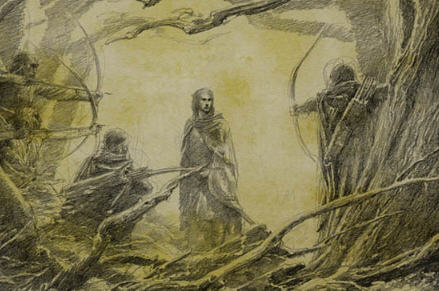
The Hills of the Hunters Beren saw 
with bare tops bitten bleak and raw
by western winds; but in the mist
of streaming rains that flashed and hissed
into the meres he knew there lay
beneath those hills the cloven way
of Narog, and the watchful halls
of Felagund beside the falls
of Ingwil
tumbling from the wold.
An everlasting watch they hold,
the Elves of Nargothrond renowned,
and every hill is tower-crowned,
where wardens sleepless peer and gaze
guarding the plain and all the ways
between Narog swift and Sirion pale;
and archers whose arrows never fail
there range the woods, and secret kill           
all who creep thither against their will.
Yet now he thrusts into that land
bearing the gleaming ring on hand
of Felagund, and oft doth cry:
'Here comes no wandering Orc of spy,
but Beren song of Barahir
who once to Felagund was dear.'
So ere he reached the eastward shore
of Narog
, that doth foam and roar
o'er boulders black, those archers green
came round him. When the ring was seen
they bowed before him, though his plight
was poor and beggarly. Then by night
they led him northward, for no ford
nor bridge was built where Narog poured
before the gates of Nargothrond,
and friend nor foe might pass beyond.

(lines 1,734 to 1767)

J.R.R. Tolkien
The Geste of Beren and Lúthien

Tolkien on the death of Lewis

I am sorry that I have not answered your letters sooner; but Jack Lewis's death on the 22nd has preoccupied me.  It is also involving me in some correspondence, as many people still regard me as one of his intimates.  Alas! that ceased to be so some ten years ago. We were separated first by the sudden apparition of Charles Williams, and then by his marriage. Of which he never even told me; I learned of it long after the event.  But we owed each a great debt to the other, and that tie with the deep affection that it begot, remains.  He was a great man of whom the cold-blooded official obituaries only scraped the surface, in places with injustice.  How little truth there may be in literary appraisals one may learn from them – since they were written while he was still alive.  Lewis only met Williams in 1939, and W. died early in 1945.  The 'space-travel' trilogy ascribed to the influence of Williams was basically foreign to Williams' kind of imagination.  It was planned years before, when we decided to divide: he was to do space-travel and I time-travel.  My book was never finished, but some of it (the Númenórean-Atlantis theme) got into my trilogy eventually.

Publication dates are not a good guide. Perelandra is dated 1943, but does not belong to that period. Williams' influence actually only appeared with his death: That Hideous Strength, the end of the trilogy, which (good though it is in itself) I think spoiled it. Also I was wryly amused to be told (D. Telegraph) that 'Lewis himself was never very fond of The Screwtape Letters' – his best-seller (250,000). He dedicated it to me. I wondered why. Now I know – says they.

From a letter to Michael Tolkien (draft)
[Not dated; November or December 1963]