Sweeter also than honey...


"More to be desired are they than gold, yea than much fine gold: sweeter also than honey and the honeycomb" (Psalm 19).

One can well understand this being said of God's mercies, God's visitations, His attributes. But what the poet is actually talking about is God's law, His commands; His "ruling" as Dr. Moffatt well translates in verse 9 (for "judgements" here plainly means decisions about conduct). What is being compared to gold and honey is those "statutes" (in the Latin version "decrees") which, we are told, "rejoice the heart". For the whole poem is about the Law, not about "Judgement" in the sense to which Chapter I was devoted.

This was to me at first very mysterious. "Thou shalt not steal, thou shalt not commit adultery" - I can understand that a man can, and must, respect these "statutes", and try to obey them, and assent to them in his heart. But it is very hard to find how they could be, so to speak, delicious, how they exhilarate. If this is difficult at any time, it is doubly so when obedience to either is opposed to some strong, and perhaps in itself innocent, desire. A man held back by his unfortunate previous marriage to some lunatic or criminal who never dies from some woman whom he faithfully loves, or a hungry man left alone, without money, in a shop filled with he smell and sight of new bread, roasting coffee, or fresh strawberries - can these find the prohibition of adultery or of theft at all like honey? They may obey, they may still respect the "statute", but surely it could be more aptly compared to the dentists's forceps or the front line than to anything enjoyable and sweet.

C.S. Lewis, Reflections on the Psalms, Chapter VI "Sweeter Than Honey" (1955) Posted by Hello

The Inquisition


One might think that the phrase of Lord Acton (that "it cannot really be held that in Rome sixteen centuries after Christ men did not know that murder was wrong") might be held to apply [to the Inquisition]; it cannot be that men did not think such methods doubtfully holy. It was not so. Deep, deeper than we believe, lie the roots of sin; it is in the good that they exist; it is in the good that they thrive and send up sap and produce the black fruits of hell. The peacock fans of holy and austere popes drove the ashes of burning men over Christendom.

Charles Williams - The Descent of the Dove  Posted by Hello

Friday 26th January, 1923

"We went at our talk like a dogfight... He (Smith) and De la Mare are fast friends and imaginative philologists of a type which they have christened 'milvers' -- partly because it is a good word, partly because it 'supplies a long felt want' in rhyming with silver. Barfield hopes soon to meet De la Mare"

"All my Road Before Me"
The Diary of CS Lewis 1922-1927

Tolkien to his son Christopher (extract)

10 April 1944

I sometimes feel appalled at the thought of the sum total of human misery all over the world at the present moment: the millions parted, fretting, wasting in unprofitable days - quite apart from torture, pain, death, bereavement, injustice. If anguish were visible, almost the whole of this benighted planet would be enveloped in a dense dark vapor, shrouded from the amazed vision of the heavens! And the products of it all will be mainly evil - historically considered. But the historic version is, of course, not the only one. All things and all deeds have a value in themselves, apart from their "causes" and "effects." No man can estimate what is really happening sub specie aeternitatis. All we do know, and that to a large extent by direct experience, is that evil labors with vast power and perpetual success - in vain: preparing always the soil for unexpected good to sprout in.

- from "The Letters of J.R.R. Tolkien"

Cobwebby hours...


I am a barbarously early riser... I love the empty, silent, dewy, cobwebby hours.

C.S. Lewis, Letters to an American Lady (30 September 1958)

 Posted by Hello

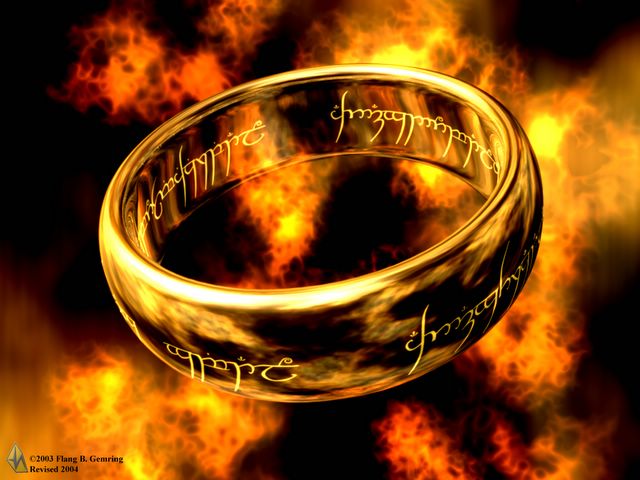
What happened to the power of the Rings once the One Ruling Ring was destroyed?


The most widely held position is that with the destruction of the One Ring all the remaining rings also lost their power (including the Three Elven Rings) and became ineffectual against the passage of time for which they were created. The reasoning behind this is because the One Ring was embodied with the power necessary to bind and control all the Rings of Power when the One's power was destroyed so was the power of all the other Rings. Those who held the Three; Gandalf, Elrond, and Galadriel departed over the sea into the West and took the Rings with them.

The evidence for this is found in several places:

"Yet many voices were heard among the Elves foreboding that, if Sauron should come again, then either he would find the Ruling Ring that was lost, or at the best his enemies would discover it and destroy it; but in either chance the powers of the Three must then fail and all things maintained by them must fade, and so the Elves should pass into the twilight and the Dominion of Men begin."
[The Silmarillion]


"But when all these things were done, and the Heir of Isildur had taken up the lordship of Men, and the dominion of the West had passed to him, then it was made plain that the power of the Three Rings also was ended, and to the Firstborn the world grew old and grey."
[The Silmarillion]


"But what would happen, if the Ruling Ring were destroyed, as you counsel? asked Gloin. We know not for certain, answered Elrond sadly. Some hope that the Three Rings, which Sauron has never touched, would then become free, and their rulers might heal the hurts of the world that he has wrought. But maybe when the One has gone, the Three will fail, and many fair things will fade and be forgotten. That is my belief."
[The Fellowship of the Ring]

The most melancholy reference is when the lady Galadriel explains to Frodo the fate of the Elves upon the outcome of the quest:

"Do you not see now wherefore your coming is to us as the footstep of Doom? For if you fail, then we are laid bare to the Enemy. Yet if you succeed, then our power is diminished, and Lothlorien will fade, and the tides of Time will sweep it away."
[The Fellowship of the Ring]

Because the primary power of the Three Rings is to slow or arrest the passage of time, Galadriel's words clearly mean that with the destruction of the One Ring, they too lose their power.
(end) Posted by Hello

What About the Powers of the Seven and Nine?


As stated, the Seven and Nine Rings were originally made by the Elves and not evil until Sauron forged the One and later took these rings by war. Their initial purpose was to slow the passage of time and preserve beauty, but since Sauron had a part in their making they became accursed and had evil powers. He gave the rings to different races of Middle-earth to enslave and so control them.

Sauron gave the Seven to the Dwarves, who proved harder to enslave:

"They ill endure the domination of others, and the thoughts of their hearts are hard to fathom, nor can they be turned to shadows. They used their rings only for the getting of wealth; but wrath and an over mastering greed of gold were kindled in their hearts..."
[The Silmarillion]


This implies their rings had other powers but were not used probably because this would draw attention to the user and all that he did.

Sauron gave the Nine to Mortal Men who proved easiest to ensnare. It was said that:

"Those who used the Nine Rings became mighty in their day, kings, sorcerers, and warriors of old. They obtained glory and great wealth... They had, as it seemed, unending life, yet life became unendurable to them. They could walk, if they would, unseen by all eyes in this world beneath the sun, and they could see things in worlds invisible to mortal men..."
[The Silmarillion]

According to The Letters of J.R.R. Tolkien #131, the Seven and Nine conferred invisibility to the user as well as unending life. However, eventually the user would fade and become a wraith under the control of Sauron, the Dark Lord.

The Three Elven Rings however, did not confer invisibility.
 Posted by Hello

What Happened to the Rings and Who Held Them?


For a brief time, all the Rings of Powers were presumably worn and used in Eregion between the time Sauron left the Elves after the rings were made (1590 SA) and when Sauron forged the One Ring (1600 SA). But as soon as Sauron put on the One Ring, the Elves took off all their rings for they finally saw through the deceptions of Sauron and realized that their creations would only be corrupted and used for evil:

"But the Elves were not so lightly to be caught. As soon as Sauron set the One Ring upon his finger they were aware of him; and they knew him, and perceived that he would be master of them, and of all that they wrought. Then in anger and fear they took off their rings."
[The Silmarillion].

Some counselled that their rings be destroyed but the Elves could not bring themselves to destroy the Rings -- and so they were hid. The Seven and the Nine were separated. Of the Three, Celebrimbor gave one, Nenya, to Galadriel, and the other two, Vilya and Narya, to Gil-galad. In turn, Gil-galad kept Vilya and gave Narya to Cirdan of the Grey Havens to hold. An alternate to this version states that during the first Council of the Second Age, it was deemed wise that Elrond receive the ring Vilya and Gil-galad kept Narya until departing to war in the Last Alliance.

Angered that his plan was revealed and failed, Sauron made war on the Elves to claim the Rings without his help they could not have made. He laid Eregion to waste and sacked the Elvish city of Ost-in-edhil. He then captured and tortured Celebrimbor into revealing where the Rings were hidden:

"There Sauron took the Nine Rings and other lesser works of the Mirdain; but the Seven and the Three he could not find. Then Celebrimbor was put to torment, and Sauron learned from him where the Seven were bestowed. This Celebrimbor revealed, because neither the Seven nor the Nine did he value as he valued the Three: the Seven and the Nine were made with Sauron's aid, whereas the Three were made by Celebrimbor alone, with a different power and purpose."
[Unfinished Tales]

Using Celebrimbor's body as a battle standard on a pole, Sauron returned with war and overran all of Eriador in search for the Three Elven Rings. But he never found them and only suspected where they were hid. With the help of the Numenoreans, Sauron was finally driven out of Eriador c. 1701 Second Age and there was peace for a long while.

Sauron's power was later challenged by the Numenoreans and he was taken back as prisoner where through the use of the One Ring he corrupted them and incited them to rebel against the Valar. Then Iluvatar was called on and the world was changed and Numenor drowned in the ocean. Sauron went down as well, but his spirit fled (with the Ring) back to Middle-earth. When he took shape again he saw how the Numenoreans had grown in strength where their new kingdoms sprang up. He resolved to make war and drive them out before they became too strong. Then the Last Alliance was formed between Elves and Men to battle Sauron. There, before the Black Tower, Barad-dur, Sauron was thrown down and vanquished in the year 3441 Second Age.

But after a respite, Sauron's spirit appeared again in the Third Age and threatened the free people in Middle-earth. Around the year 1000 Third Age the Istari, or Wizards, came to Middle-earth to help in the struggle against Sauron. Last to come was Gandalf and Cirdan was moved to give Narya to Gandalf as he saw that it would be put to better use:

"Take now this Ring, he said; for thy labours and thy cares will be heavy, but in all it will support thee and defend thee from weariness. For this is the Ring of Fire, and herewith, maybe, thous shalt rekindle hearts to the valour of old in a world that grows chill."
[The Silmarillion]

So at the time of the story of Lord of the Rings, the Three Elven Rings were in the hands of the Wise; Gandalf, Elrond, and Galadriel, the Nine Sauron held, as well as four of the Seven (the other three were consumed by dragons), and the One was in the hands of Frodo the Hobbit.
 Posted by Hello

Why were the Rings of Power Made, and what were their Powers?


(John Howe)

The reason is tied to the regret the Elves had for the passage of time. The Elves were immortal and were fated to live as long as Middle-earth lasted. As such, the earth changed with the passage of time, and the Elves saw many things that were fair become destroyed and lost by the hurts of evil. Sauron, as tempter, awoke a desire in the hearts of Elves to heal the hurts of the earth and create a paradise on this side of the sea to compare to Valinor -- and to be its rulers; whereas in Valinor they were only subjects and below the Valar. The Rings of Power were primarily made to slow the passage of time and preserve their creations of beauty. Yet they had other powers as well.

Tolkien provides a revealing insight on to the nature of the Rings and their powers in one of his letters:

"The chief power (of all the rings alike) was the prevention or slowing of decay (i.e. 'change' viewed as a regrettable thing), the preservation of what is desired or loved, or its semblance - this is more or less an Elvish motive. But also they enhanced the natural powers of a possessor - thus approaching 'magic', a motive easily corruptible into evil, a lust for domination. And finally they had other powers, more directly derived from Sauron... such as rendering invisible the material body, and making things of the invisible world visible."
[The Letters of J.R.R. Tolkien #131]

The Rings were not made as instruments of war or domination; they could not create lightning bolts or hail storms. Yet, they conferred powers commensurate with that of the user; a Great Ring in the hands of a weak and lesser person could not work effects to the extent of the wise or great. Notice Galadriel's words to Frodo in Lothlorien:

"Did not Gandalf tell you that the rings give power according to the measure of each possessor? Before you could use that power you would need to become far stronger, and to train your will to the domination of others."
[The Fellowship of the Ring]

The Elves used the Three Rings to create "islands of timeless beauty" and guard them against the passage of time and evil. Their use can be seen at work at various points:

~ Elrond used the power of his ring, Vilya, to cause the flood
of the river Bruinen when the Nazgul tried to capture Frodo.

~ Galadriel used the power of her ring, Nenya, to keep a guard
on Lothlorien so that none could enter without her leave.

~ Gandalf used the power of his ring, Narya, to kindle the hearts
and spirits of the enemies of Sauron to do great deeds. And quite
possibly to assist him in his battle to the death with the Balrog.

But the use of the Elven Rings was possible only after Sauron was defeated in the Second Age and his Ring taken and assumed lost. If Sauron regained the One, then all the works of the Elves and the use of their Rings would be subject to the evil will of Sauron.
 Posted by Hello

How many Rings of Power were Made?


The verse in the Lord of the Rings makes explicit reference to 20 Rings of Power:

Three Rings for the Elven-kings under the sky,
Seven for the Dwarf-lords in their halls of stone,
Nine for Mortal Men doomed to die,
One for the Dark Lord on his dark throne
In the Land of Mordor where the Shadows lie.
One Ring to rule them all, One Ring to find them.
One Ring to bring them all and in the darkness bind them
In the Land of Mordor where the Shadows lie.

These are the Rings of Power made in the Second Age and concern the events of the Third Age.
 Posted by Hello

A garden...


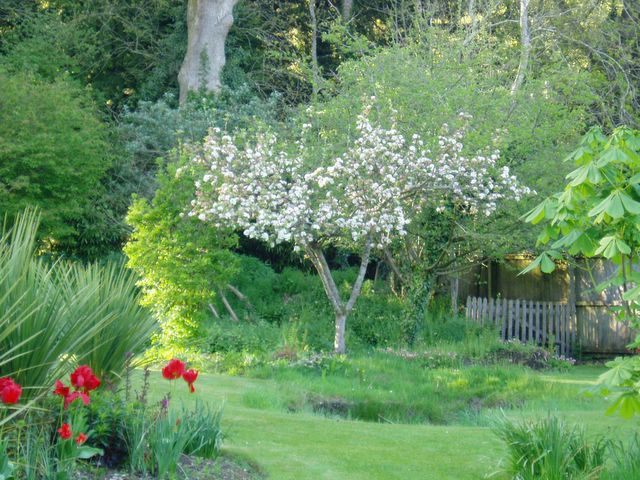
A garden...teems with life. It glows with colour and smells like heaven and puts forward at every hour of a summer day beauties which man could never have created and could not even, on his own resources, have imagined...when the garden is in its full glory the gardener's contributions to that glory will still have been in a sense paltry compared with those of nature. Without life springing from the earth, without rain, light and heat descending from the sky, he could do nothing. When he has done all, he has merely encouraged here and discouraged there, powers and beauties that have a different source.

C.S. Lewis, The Four Loves (1960)
 Posted by Hello

Húrin on Thangorodrim


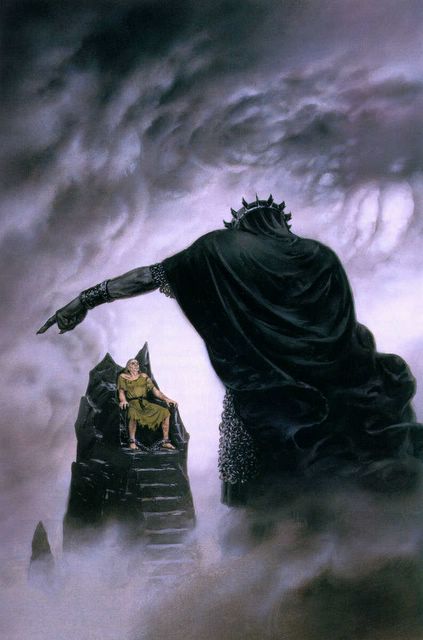
(Húrin on Thangorodrim [Ted Nasmith])

Tolkien loved archaic language, in which he often used far beyond the tolerance of the modern reader, when he wrote alliterative verse. He sometimes succumbed to all the temptations the alliterative form offers to a literary scholar: the opportunity to use archaic words to meet the alliterative requirements, the temptation to distort the syntax to meet the rhythmic demands of Anglo-Saxon alliterative meter, and various other sins less besetting, such as the temptation to include filler material for the sake of the meter. However, once tuned into Tolkien's world, the difficulties fall away in a plethora of wonderful, and often terrifying images:

Then Thalion was thrust to Thangorodrim,
that mountain that meets the misty skies
on high o'er the hills that Hithlum sees
blackly brooding on the borders of the north,
To a stool of stone on its steepest peak
they bound him in bonds, an unbreakable chain,
and the Lord of Woe there laughing stood,
then cursed him for ever and his kin and seed
with a doom of dread, of death and horror.
There the mighty man unmoved sat;
but unveiled was his vision, that he viewed afar
all earthly things with his eyes enchanted
that fell on his folk- a fiend's torment.

(The Lay of the Children of Húrin, lines 92-104)

 Posted by Hello

Bors to Elayne (Kings Coins - Final)


The Archbishop answered the lords;
his words went up through a slope of calm air:
'Might may take symbols and folly take treasure,
and greed bid God, who hides himself for man's pleasure
by occasion, hide himself essentially: this abides -
that the everlasting house the soul discovers
is always another's; we must always lose our own ends;
we must always live in the habitation of our lovers,
my friend's shelter for me, mine for him.
This is the way of this world in the day of that others';
make yourselves friends by means of the riches of iniquity,
for the wealth of the self is the health of the self exchanged.
What saith Heracleitus? - and what is the City's breath? -
dying each other's life, living each other's death.
Money is a medium of exchange.'

Arthurian Poets (The Boydell Press) 1991
(extract)
 Posted by Hello

Bors to Elayne (Kings Coins - III)


Taliessin's look darkened; his hand shook
while he touched the dragons; he said 'We had a good thought.
Sir, if you made verse you would doubt symbols.
I am afraid of the little loosed dragons.
When the means are autonomous, they are deadly; when words
escape from verse they hurry to rape souls;
when sensation slips from intellect, expect the tyrant;
the brood of carriers levels the good they carry.
We have taught our images to be free; are we glad?
are we glad to have brought convenient heresy to Logres?'
 Posted by Hello

Bors to Elayne (Kings Coins - II)


They had the coins before the council.
Kay, the king's steward, wise in economies, said:
'Good; these cover the years and the miles
and talk one style's dialects to London and Omsk.
Traffic can hold now and treasure be held,
streams are bridged and mountains of ridged space
tunnelled; gold dances deftly across frontiers.
The poor have choice of purchase, the rich of rents,
and events move now in a smoother control
than the swords of lords or the orisons of nuns.
Money is the medium of exchange.
 Posted by Hello

Bors to Elyane: on the King's Coins


Over the next week or so we will have the opportunity of reading excerpts from Charles Williams "Bors to Elayne: on the King's Coins", one of the more accessible poems in TALIESSIN THROUGH LOGRES. On the surface about coinage, but at a much deeper level a vehicle for Williams to explore co-inherence... or as he has it here: The means of exchange.

The king has set up his mint by Thames.
He has struck coins; his dragon's loins
germinate a crowded creaturely brood
to scuttle and scurry between towns and towns,
to furnish dishes and flagons with change of food;
small crowns, small dragons, hurry to the markets
under the king's smile, or flat in houses squat.
The long file of their snout crosses the empire,
and the other themes acknowledge our king's head.
They carry on their backs little packs of value,
caravans; but I dreamed the head of a dead king
was carried on all, that they teemed on house-roofs
where men stared and studied them as I your thumbs' epigrams,
hearing the City say Feed my lambs
to you and the king; the king can tame dragons to carriers,
but I came through the night, and saw the dragonlets' eyes
leer and peer, and the house-roofs under their weight
creak and break; shadows of great forms
halloed them on, and followed over falling towns.
I saw that this was the true end of our making;
mother of children, redeem the new law.
 Posted by Hello

Oxford Crematorium


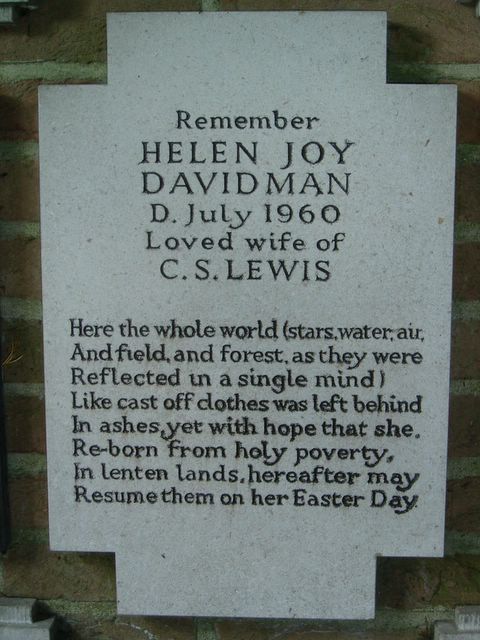
In Oxford Crematorium, just outside one of the chapels there is a small plaque on the wall. It was placed there at the behest of C.S. Lewis following the death of his beloved wife Joy Davidman. It reads: "Remember Helen Joy Davidman (loved wife of C. S. Lewis). Here the whole world (stars, water, air and field, and forest, as they were reflected in a single mind) like cast off clothes was left behind in ashes, yet with hope that she, reborn from Holy poverty, in Lenten lands, hereafter may Resume them on her Easter Day."  Posted by Hello

The Baby and the Bird


Old Rome had many taverns
Devoted to the vine,
Where Ovid pledged each new love
In red Falernian wine;
Catullus, shamed by Lesbia,
Poured out his grief in verse;
Apuleus noted follies,
And pondered which was worse.

Refrain:
But the place that draws me ever
When my fancy's running wild,
Is a little pub in Oxford
Called The Eagle and the Child,
The Eagle and the Child, oh,
Or else, as I have heard
Its regulars all called it--
The Baby and the Bird!


The company was lively
In Soutwark's Tabard Inn,
When Chaucer and the Pilgrims
Were telling tales within,
And on the Canterbury road
They took that April day,
And at the other hostels
Where they stayed upon their way.

(REFRAIN)

When Villon, gutter-poet,
Reeled through the Paris night,
Drunk on verse and hypocras
And looking for a fight,
The Pomme de Pin, the Cheval Blanc
All welcomed him, and more,
With wine at every table
And doxies at each door.

(REFRAIN)

Of all the City's taverns,
When Bess was England's Queen,
The Mermaid, undisputed, ruled
The literary scene.
Each Global play was played again
And christened in brown ale,
Whde Shakespeare, or Ben Jonson,
Stood up to tell the tale.

(REFRAIN)

Augustan wits made merry
At London's Cheshire Cheese--
The topic was no matter,
So that the manner please--
Be it Love or Politicks,
'Twas scandalous, I've heard,
And Johnson had his Boswell
To write down every word.

(REFRAIN) Asking,

They sing of famous taverns,
But considering them all,
The one where I had rather
Been a fly upon the wall,
Would be the Inn where Tolkien,
Lewis, Williams too,
Met with the other Inklings
Asking, "Who has something new?"

(Diana L Paxson)


Diana L. Paxson, long-time active in ‘The Mythopoeic Society’, and in ‘The Society for Creative Anachronism’, is the author of many novels, including The White Raven, The "Fionn MacCumhal trilogy, and a trilogy on the Siegfried legend, the most recent volume of which, The Lord of Horses, has been published recently.

When I'm in Oxford I often go there for lunch - they do a decent pub lunch. The Eagle & The Child is on the west side of the Woodstock Road just as the Banbury Road is forking off of it, about 1/2 mile north of the city centre. They have a lovely display of photos of the Inklings, and the lyrics to "The Baby and The Bird".
 Posted by Hello

The man born to be King


"For whatever reason God chose to make man as he is - limited and suffering and subject to sorrows and death -- he had the honesty and courage to take his own medicine. Whatever game he is playing with his creation, he has kept his own rules and played fair. He can exact nothing from man that he has not exacted from himself. He has himself gone through the whole human experience, from the trivial irritations of family life and the cramping restrictions of hard work and lack of money to the worst horrors of pain and humiliation, defeat, despair, and death. When he was a man, he played the man. He was born in poverty and died in disgrace and thought it well worthwhile."

"The Man born to be king" - Dorothy L. Sayers

Like her friends C.S. Lewis, T.S. Eliot, and Charles Williams, Sayers was a brilliant Christian thinker... who took doctrine seriously and bristled at the growth of "fads, schisms, heresies, and anti-Christ" within the Church of England. Just how satisfying Christianity was for her became clear in 1938 when she wrote a Sunday editorial for the Times: "The Christian faith is the most exciting drama that ever staggered the imagination of man...and the dogma is the drama."

"The man born to be king" a radio drama in six parts first broadcast in 1943 was instigated as a direct result of encouragement from Jack Lewis. Posted by Hello

An Inklings meeting...


"I can see the room so clearly now, the electric fire pumping heat into the dank air, the faded screen that broke some of the keener draughts, the enamel beer-jug on the table, the well-worn sofa and armchairs, and the men drifting in... leaving overcoats and hats in any corner and coming over to warm their hands before finding a chair. There was no fixed etiquette, but the rudimentary honours would be done partly by Lewis and partly by his brother... Sometimes, when the less vital members of the circle were in a big majority the evening would fall flat; but the best of them were as good as anything I shall live to see."

Sprightly Running (John Wain)

It was in this setting that, along with from lively talk about many things, and without an iota of self-consciouness about securing a place in history, Tolkien's The Lord of the Rings, C.S.Lewis's The Problem of Pain, The Screwtape Letters, The Great Divorce, Charles Williams's All Hallow's Eve, and Warnie Lewis's The Splendid Century were - along with other works by other members - read and discussed. Those of us who did not enjoy the privilege of being there can at least imagine what it must have been like to read one's own work to such a friendly but formidable jury.
 Posted by Hello