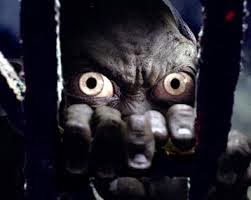
"I myself am not fit to run a henhouse"

I think Lewis was so compelling because, first, he was incomparable at evoking "joy" as he defined it. Whatever idea and yearning for "heaven" I ever had came from Narnia. Second, I think he had an intuitive -- not theoretical -- grasp of psychology -- he was one of those people who reads his own mind so well, he knows a good deal about how all human minds (and wills and emotions) work.The bickering of the children in The Magician's Nephew, Eustace's redemption in Dawn Treader, the seeds of human hatred elucidated by Screwtape -- and above all, the parental love turned to jealous gall in Till We Have Faces -- his greatest imaginative leap and rendition of the romance of the soul --have a kind of easy, intimate verity that give his spiritual dramas life.

At the same time, when it came to doctrine and apologetics, I think he was an unwitting sophist -- an honest sophist, if that makes any sense, because he fooled himself first.

He had a ridiculously thin dodge against the then au courant Freudian claims that God was the expression of various unconscious wishes: that we have equally strong unconscious wishes for there to be no God. Not true, where he was concerned. His need is palpable -- and poignant, given the brutalities and deprivations of his childhood and early manhood -- his mother's death at eight, a school he called "Belsen" and others almost equally brutal, and then a stint in the trenches beginning on his nineteenth birthdy and ending months later with a serious wound (he found school more trying). If anyone ever needed an omniscient, omnibenevolent parent, it was CSL.

His motives can't be proved. Fair enough. What's palpably ridiculous are his warmed-over medieval arguments for the objective truth of Christian doctrine. One was that Christ had to be "either a God or a devil" - or self-delusive megalomaniac, as we'd now say. While sniping at the imperfections of scientific Biblical scholarship, Lewis shut his eyes to the painstaking work of two centuries that convincingly discerned different voices, sources, periods, influences on Biblical text. There's also no recognition in his work that people from different eras might perceive and express truth differently -- i.e., that someone in an earlier era who claimed to deliver God's words directly might be neither a fraud nor God's stenographer.

Then there's the cultural chauvinism in his claims that other religious traditions foreshadowed or provided latter-day distortions of Christianity -- the one truth, which worked like something "gradually coming into focus." And the absurd argument that God would create the physical laws of the universe in part to get our attention by His deliberate breaking of them through miracles. And his over-correction of what he called (this may be a paraphrase) our era's chronological snobbery -- an assumption that new ideas are inherently superior to old ones. Lewis, making the opposite error, refused to acknowledge any lasting advances in political ethics or developments in our understanding of human rights.

What's all this got to do with your conservatism? Lewis's politics in the broadest sense, I suspect, inform yours. He's one of your conservatives of doubt -- dubious about the efficacy of human attempts to permanently improve human life. He's a democrat (small d, believer in democracy) by default, of the Churchillian school that democracy is the worst form of government except for all the alternatives. His own formulation was that democracy is necessary because human corruption means that no individual or small group can be trusted with power. That's true, and salutary.

What Lewis lacked was any sense that participating in political life is part of what makes us fully human -- and the corollary, that a people's meaningful participation in politics could permanently advance human welfare. Strange, for a man steeped in Greek literature -- no sense that man is a political animal. He charmingly wrote, "I myself am not fit to run a henhouse." Well, neither am I. But that doesn't mean I have no role or responsibility in governance, and that if all were well I'd live like one of Lewis's Narnian badgers, in peaceful quietism. And while you, Andrew, are a very political animal, you share Lewis' unduly limited sense of what government and politics can accomplish. I recognize, with Obama, that Reagan had a lasting insight, and that the lasting pressure he put on liberalism not to bloat government, not to intrude it into every aspect of our lives, not to let it suck any more resources out of the private sector than it needs to perform its functions at maximum efficiency, is salutary. But to go from there to an assumption that government can't improve on its furtherance of commonwealth, that it can't fairly counteract rising income inequality or spread the most fundamental risks, like illness or destitution in old age, more effectively than it does now, is defeatist.

Phillip Pullman, author of the fantasy series His Dark Materials, has attacked Lewis with Oedipal fervor as being politically repressive, indoctrinating children to be obedient uber alle -- obedient to manifestly present gods and kings. There's an element of truth in this. Lewis sees human beings essentially as subjects, not citizens. In Lewis' fantasy, kings rule for the benefit of the governed, subject spontaneously offer up their loyalty, chivalry works as advertised, and the good guys' wars are always purely defensive. But Pullman misses Lewis' core anti-authoritarianism. When Lewis said that the desire to be left alone is as strong as the desire for a heavenly father, he was speaking to the heart to the extent that he did heartily want to be left alone, and he wanted everyone else to be, too. His benevolent rulers don't intrude in their subjects' lives. He had a great imaginative grasp of tyrants whose core assumption is that their subjects exist to serve them. And he provides for children the great pleasure of well-dramatized rebellions against bullies and tyrants. In fact Pullman respects raw power more than Lewis does, and he's more dogmatic in his anti-monotheism than Lewis ever was in his 'mere Christianity.'
.
The Atlantic ~ March 2009

All that is not Eternal

Theologians have sometimes asked whether we shall "know one another" in Heaven, and whether the particular love-relations worked out on earth would then continue to have any significance. It seems reasonable to reply: "It may depend what kind of love it had become, or was becoming, on earth." For, surely, to meet in the eternal world someone for whom your love in this, however strong, had been merely natural, would not be (on that ground) even interesting.

Would it not be like meeting in adult life someone who had seemed to be a great friend at your preparatory school solely because of common interest and occupations? If there was nothing more, if he was not a kindred soul, he will now be a total stranger. Neither of you now plays conkers. You no longer want to swop your help with his French exercise for his help with your arithmetic.

In Heaven I suspect, a love that had never embodied Love Himself would be equally irrelevant. For Nature has passed away. All that is not eternal is eternally out of date.

C.S. Lewis, The Four Loves: Charity (1960)

Via Mortis

At first he did not believe. This was certainly the place, though in the dawn which was less bright than the moon, and he knew he had hated the moon because it watched him, the corners of that stage between earth and sky were now in darkness. But he went and peered into them and felt. Uselessly. He knelt down, staring round, unaware of any sickness or exhaustion, only of anxiety. He almost lay down, screwing up his eyes, dragging himself round. It was all useless. The rope was not there.

By now, as he raised his head and looked out, the silence was beginning to trouble him, and the pallid dawn. It was good that the light should not grow, but also it was terrifying. There had not been much time, or had there? He could not attend to it; the absence of the rope preoccupied him. Could someone, out of the world that was filled with his rich enemies, have come, while he was down at the foot, doing something he could not remember, and run up the ladder quietly, and stolen back his rope as he himself had stolen it? Perhaps the men who had sent him off that day, or even his wife, out of the room, stretching a lean hand and snatching it, as she had snatched things before-but then she would have snarled or shrilled at him; she always did. He forgot his caution. He rose to his feet, and ran round and round seeking for it. He failed again; the rope was not there.

By the ladder he stood still, holding on to it, utterly defeated at last, in a despair that even he had never felt before. There had always been present to him, unrecognized but secure, man's last hope, the possibility of death. It may be refused, but the refusal, even the unrecognized refusal, admits hope. Without the knowledge of his capacity of death, however much he fear it, man is desolate. This had gone; he had no chance whatever. The rope was gone; he could not die. He did not yet know that it was because he was already dead.

Charles Williams
Descent into Hell (1937)
(Ch 2 'Via Mortis')

A letter to Rayner Unwin


From a letter to Rayner Unwin


 8 December 1955

[The radio adaptation of The Lord of the Rings was discussed on the BBC programme 'The Critics'; and on 16 November, W. H. Auden gave a radio talk about the book in which he said: 'If someone dislikes it, I shall never trust their literary judgement about anything again.'  Meanwhile Edwin Muir, reviewing The Return of the King in the Observer on 27 November, wrote: 'All the characters are boys masquerading as adult heroes ... and will never come to puberty. ... Hardly one of them knows anything about women.']

I agreed with the 'critics' view of the radio adaptation; but I was annoyed that after confessing that none of them had read the book they should turn their attention to it and me — including surmises on my religion.  I also thought Auden rather bad – he cannot at any rate read verse, having a poor rhythmical sense; and deplored his making the book 'a test of literary taste'.  You cannot do that with any work – and if you could you only infuriate.  I was fully prepared for Robert Robinson's rejoinder 'fair-ground barker'.  But I suppose all this is good for sales.  My correspondence is now increased by letters of fury against the critics and the broadcast.  One elderly lady – in part the model for 'Lobelia' indeed, though she does not suspect it – would I think certainly have set about Auden (and others) had they been in range of her umbrella.

(...)

I hope in this vacation to begin surveying the Silmarillion; though evil fate has plumped a doctorate thesis on me...

Blast Edwin Muir and his delayed adolescence.  He is old enough to know better.  It might do him good to hear what women think of his 'knowing about women', especially as a test of being mentally adult.  If he had an M.A. I should nominate him for the professorship of poetry – a sweet revenge.

The Letters of J.R.R. Tolkien

Latin, Greek, Anglo-Saxon & Gothic... Welsh and Finnish

Yes, it's JRRT at the back holding on to the tree.  Exeter College, Oxford students in June 1914.  Within 4 years many of these young men would be dead.  I hope you will not mind a personal comment from me, "What a waste."

I am afraid this is becoming a dreadful bore, and going on too long, at any rate longer than 'this contemptible person before you' merits. But it is difficult to stop once roused on such an absorbing topic to oneself as oneself. As for the conditioning: I am chiefly aware of the linguistic conditioning. I went to King Edward's School and spent most of my time learning Latin and Greek; but I also learned English. Not English Literature! Except Shakespeare (which I disliked cordially), the chief contacts with poetry were when one was made to try and translate it into Latin. Not a bad mode of introduction, if a bit casual. I mean something of the English language and its history. I learned Anglo-Saxon at school (also Gothic, but that was an accident quite unconnected with the curriculum though decisive — I discovered in it not only modern historical philology, which appealed to the historical and scientific side, but for the first time the study of a language out of mere love: I mean for the acute aesthetic pleasure derived from a language for its own sake, not only free from being useful but free even from being the 'vehicle of a literature').

There are two strands, or three. A fascination that Welsh names had for me, even if only seen on coal-trucks, from childhood is another; though people only gave me books that were incomprehensible to a child when I asked for information. I did not learn any Welsh till I was an undergraduate, and found in it an abiding linguistic-aesthetic satisfaction. Spanish was another: my guardian was half Spanish, and in my early teens I used to pinch his books and try to learn it : the only Romance language that gives me the particular pleasure of which I am speaking - it is not quite the same as the mere perception of beauty: I feel the beauty of say Italian or for that matter of modern English (which is very remote from my personal taste): it is more like the appetite for a needed food. Most important, perhaps, after Gothic was the discovery in Exeter College library, when I was supposed to be reading for Honour Mods, of a Finnish Grammar. It was like discovering a complete wine-cellar filled with bottles of an amazing wine of a kind and flavour never tasted before. It quite intoxicated me; and I gave up the attempt to invent an 'unrecorded' Germanic language, and my 'own language' – or series of invented languages – became heavily Finnicized in phonetic pattern and structure.

The Letters of J.R.R. Tokien
7 June 1955 (To W.H. Auden)

Taliessin through Loegres


With the governments throughout the world now seeking to impose a foreign 'morality' on it's Christian subjects, I was reminded of the Prelude to Williams 'Taliessin' poems, and in particular the first two lines of 'Prelude II'. The whole context of Williams words here seem strangely prescient in the world of 2013 where once again we are engulfed in a battle of ideologies.

As Williams writes, "The blind rulers of Logres...", encapsulating for me the whole leadership of the liberal, I would say libertine, West. But what do you think?

Prelude

I
Recalcitrant tribes heard;
orthodox wisdom sprang in Caucasia and Thule;
the glory of the Emperor stretched to the ends of the world.
In the season of midmost Sophia
the word of the Emperor established a kingdom in Britain;
they sang in Sophia the immaculate conception of wisdom.
Carbonek. Camelot, Caucasia,
were gates and containers, intermediations of light;
geography breathing geometry, the double-fledged Logos.

II
The blind rulers of Logres
nourished the land on a fallacy of rational virtue;
the seals of the saints were broken; the chairs of the Table reeled.
Galahad quickened in the Mercy;
but history began; the Moslem stormed Byzantium;
lost was the glory, lost the power and kingdom.
Call on the hills to hide us
lest, men said in the City, the lord of charity
ride in the starlight, sole flash of the Emperor's glory.

III
Evil and good were twins
once in the alleys of Ispahan; the Moslem
crying Alla il Alla destroyed the dualism of Persia.
Caucasia fell to the Moslem;
the mamelukes seized the ancient cornland of Empire.
Union is breached; the imams stand in Sophia.
Good is God, the muezzin
calls, but lost is the light on the hills of Caucasia,
Glory of the Emperor, glory of substantial being.

Charles Williams (1938) 

Gangrel

“He is only a wretched gangrel creature, but I have him under my care for a while.” (Frodo, speaking of Gollum to Faramir : LotR iv. iv)

The choice of this unusual word is doubly appropriate. The first sense in the OED is 'a vagabond' and, when used as an adjective, ‘vagrant': Was it a light thing that gangrel thieves should burn and waste in Mid-mark and depart unhurt, that ye stand here with clean blades and cold bodies?
(William Morris The House of the Wolfings, chapter xxii)

The second sense is 'a lanky loose-jointed person', which may seem equally apt for the agile Gollum. The word is a Middle English formation which adds a disparaging suffix (also seen in mongrel and wastrel) to a stem apparently meaning 'go or walk'.

Tolkien also used the word (but only in the first sense) in Feanor's dismissal of Melkor: “Get thee from my gate, thou gangrel” ('Annals of Anian' 97)

The Ring of Words ~
Tolkien and the Oxford English Dictionary
Oxford University Press (2006)

The Opening of the Graves

Margaret Anstruther was buried on the next day but one, to the sound of that apostolic trumpet which calls on all its hearers to rise from the dead, and proclaims the creation on earth of celestial bodies, "sown in corruption, raised in incorruption; sown in dishonour, raised in glory; sown in weakness, raised in power". "Be steadfast, unmovable . . . your labour is not in vain in the Lord." Pauline heard with a new attention; these were no longer promises, but facts. She dared not use the awful phrases for herself; only, shyly, she hoped that perhaps, used by some other heavenly knowledge, they might not be altogether inapplicable to herself. The epigram of experience which is in all dogma hinted itself within her. But more than these passages another stranger imagination struck her heart: "Why are they then baptized for the dead?" There, rooted in the heart of the Church at its freshest, was the same strong thrust of interchange. Bear for others; be baptized for others; and, rising as her new vision of the world had done once and again, an even more fiery mystery of exchange rolled through her horizons, turning and glancing on her like the eyed and winged wheels of the prophet. The central mystery of Christendom, the terrible fundamental substitution on which so much learning had been spent and about which so much blood had been shed, showed not as a miraculous exception, but as the root of a universal rule . . . "behold, I shew you a mystery", as supernatural as that Sacrifice, as natural as carrying a bag. She flexed her fingers by her side as if she thought of picking one up.

Charles Williams “Descent into Hell”, Chapter 11, ‘The Opening of the Graves’

An Inklings Meeting

"I can see the room so clearly now, the electric fire pumping heat into the dank air, the faded screen that broke some of the keener draughts, the enamel beer-jug on the table, the well-worn sofa and armchairs, and the men drifting in... leaving overcoats and hats in any corner and coming over to warm their hands before finding a chair. There was no fixed etiquette, but the rudimentary honours would be done partly by Lewis and partly by his brother... Sometimes, when the less vital members of the circle were in a big majority the evening would fall flat; but the best of them were as good as anything I shall live to see."

Sprightly Running (John Wain)

It was in this setting that, along with from lively talk about many things, and without an iota of self-consciouness about securing a place in history, Tolkien's The Lord of the Rings, C.S.Lewis's The Problem of Pain, The Screwtape Letters, The Great Divorce,Charles Williams's All Hallow's Eve, and Warnie Lewis's The Splendid Century were - along with other works by other members - read and discussed. Those of us who did not enjoy the privilege of being there can at least imagine what it must have been like to read one's own work to such a friendly but formidable jury.

Gondolin

As recounted in The Silmarillion, the Vala Ulmo, the Lord of Waters, revealed the location of the Vale of Tumladen to the Ñoldorin Lord Turgon in a dream. Under this divine guidance, Turgon travelled from his kingdom in Nevrast and found the vale. Within the Echoriath, the Encircling Mountains, just west of Dorthonion and east of the River Sirion, lay a round level plain with sheer walls on all sides and a ravine and tunnel leading out to the southwest known as the Hidden Way. In the middle of the vale there was a steep hill which was called Amon Gwareth, the "Hill of Watching". There Turgon decided to found a great city that would be protected by the mountains and hidden from the Dark Lord Morgoth. 

Turgon and his people built Gondolin in secret. After it was completed, he took with him to dwell in the hidden city his entire people in Nevrast — almost a third of the Ñoldor — as well as nearly three quarters of the northern Sindar. He originally named the city Ondolindë, which is Quenya for "The Rock of the Music of Water" after the springs of Amon Gwareth. The name was later changed to its Sindarin form. 

The Hidden Way was protected by seven gates, all constantly guarded; the first of wood, then stone, bronze, iron, silver, gold, and steel. The city stood for nearly 400 years until it was betrayed to Morgoth by Maeglin, Turgon's nephew, and sacked by the Dark Lord's armies. 

A Memory of Lewis

I know myself what others know far better - how unfailingly courteous Lewis was in answering letters. I think I corresponded with him on three or four occasions... there was a reply every time - it might be quite brief, but it was always written for you and for nobody else. I think this was his greatest secret.

He hated casual contacts; human contact must, for him, be serious and concentrated and attentive, or it was better avoided. It might be for a moment only, but that was its invariable quality. That is not only why so many people have precious memories of him; it is also why he couldn't write three words without the reader's feeling that they were written for him and him alone. It's why his massive books of scholarship read as delightfully as his children's stories, and why he's one of the few preachers who can be read without losing their message."

Erik Routley, "A Prophet", C.S. Lewis at the Breakfast Table and Other Reminiscences

The Inquisition


The devil, even if he is a fact, has been an indulgence;… while he exists, there is always something to which we can be superior.

One might think that the phrase of Lord Acton (that “it cannot really be held that in Rome sixteen centuries after Christ men did not know that murder was wrong”) might be held to apply [to the Inquisition]; it cannot be that men did not think such methods doubtfully holy. It was not so. Deep, deeper than we believe, lie the roots of sin; it is in the good that they exist; it is in the good that they thrive and send up sap and produce the black fruits of hell. The peacock fans of holy and austere popes drove the ashes of burning men over Christendom.

Charles Williams
'The Descent of the Dove'
Longmans, Green and Co (1939)

Eleventy-one and Gross

In the first chapter of The Lord of the Rings, Bilbo is about to reach the age of eleventy-one, in, 'a rather curious number', and at his birthday party, his announcement 'I am eleventy-one today' is met with cheers from the assembled guests. In English there are other invented terms for numbers representing tens, most famously umpty, which is now almost forgotten, but on which was based the very common word umpteen. It would be easy to see this as a piece of whimsical fancy based on Lewis Carroll logic: if we can count to ninety, why not eleventy?

But as always with Tolkien, the roots go deeper, and are planted in the reality of the culture of the ancient world. In Old Eng­lish, the next two tens after hund 'hundred' were hundendlufontig and hundtwelftig: the hund- was a prefix, which also occurred in hundeahtatig 'eighty' and hundnigontig 'ninety'; if we remove the prefix, we get -endlufontig 'eleventy' from endlufon or endleofon 'eleven' and -twelftig 'twelfty'. Why did the Anglo-Saxons count up to 'twelfty'? The answer lies in an ancient system of counting in twelves; much later, at the end of the Middle English period, certain commodities, such as fish, were counted in 'hundreds' that actually contained six score or 120, and this was known as the 'great hundred' or 'long hundred' (OED: hundred n. and a., sense 3). That this probably goes back to ancient times is shown by the fact that in Old Norse 100 was tiu tigir'ten tens', 110 was ellifu tigir 'eleven tens' (exactly parallel to eleventy), and 120 was hundrad 'hundred'. There are even said to be ordinal numerals titugandi and ellifu-tugandi 'tentieth' and 'eleventieth'.

Similarly, the OED shows that, from around 1400, many com­modities were reckoned by the gross (OED: gross n.3), which sig­nified 12 dozen (144). We know that the hobbits used this reckoning from another place in the same chapter, where we are told that the invitations to the special family dinner party were limited to twelve dozen, 'a number also called by the hobbits one Gross, though the word was not considered proper to use of people' — Bilbo offends his guests later in the speech already referred to, by doing just that. The party is even punningly described as 'an engrossing entertain­ment', although the sentence containing this phrase no longer con­tains the mention of  '144' present in the early draft (HMEVl. 23), so many readers miss the pun.

Tolkien is imagining, as with many other matters, that the hobbits continued a practice used by our forefathers. But he presum­ably also knew that the OED has an entry for the similarly formed word eleventeen meaning 'twenty-one', which was used by a 17th-century writer named George Wither (and also revived in a Vic­torian farce by Charles Selby in 1858}. It is also quite probable that he had come across this gloss for the Icelandic word ellefu-tiu in Cleasby and Vigfusson's Icelandic-English Dictionary (1874): '"eleventy" (i.e. one hundred and ten),,..frequent in reckoning by duodecimal hundreds'.

The Ring of Words
(OUP 2006)

Pattern

Some believe the slumber
Of trees is in December
When timber's naked under sky
And squirrel keeps his chamber.

But I believe their fibres
Awake to life and labour
When turbulence comes roaring up
The land in loud October,

And plunders, strips, and sunders
And sends the leaves to wander
And undisguises prickly shapes
Beneath the golden splendour.

Then form returns. In warmer,
Seductive days, disarming
Its firmer will, the wood grew soft
And put forth dreams to murmur.

Into earnest winter
With spirit alert it enters;
The hunter wind and the hound frost
Have quelled the green enchanter.

Poems - C.S. Lewis (1964)

Jack, on hearing of the acceptance for publication of "The Lord of the Rings"


To J.R.R. Tolkien

[Magdalen College]

Nov 13/52

My dear Tollers

Just a note to tell you with what agreeable warmth and weight your yesterday’s good news lies on my mind – with an inward chuckle of deep content. Foremost of course is the sheer pleasure of looking forward to having the book to read and re-read. But a lot of ther things come in. So much of your whole life, so much of our joint life, so much of the war, so much that seemed to be slipping away quite spurlos into the past, is now, in a sort made permanent.

And I am of course very glad on your account too. I think the very prolonged pregnancy has drained a little vitality from you: there’ll be a new ripeness and freedom when the book’s out. And how pleased Priscilla and Mrs. Farrer will be. God bless you.

J.

(spurlos = without trace)
Collected Letters, Volume III (2006)

Before the publication of 'The Hobbit'

Mr Lewis of Magdalen, who reviews for the Times Literary Supplement, tells me that he has already written urging a review and claiming the book as a specialist in fairy-stories; and he is now disgruntled because he will get 'juveniles' that he does not want, while the Hobbit will not reach him until the vacation is over, and will have to wait till December to be read & written up properly.  Also if the book had been available before the university disintegrates I could have got my friend the editor of the O.U. Magazine, who has been giving it a good dose of my dragon-lore recently, to allocate it and get a review at the beginning of the autumn term.  However, I say these things too late I expect.  In any case I do not suppose it makes in the long run a great deal of difference.  I have only one personal motive in regretting this delay: and that is that I was anxious that it should appear as soon as possible, because I am under research-contract since last October, and not supposed to be indulging in exams or in "frivolities'.  The further we advance into my contract time, the more difficulty I shall have (and I have already had some) in pretending that the work belongs wholly to the period before October 1936. I shall now find it very hard to make people believe that this is not the major fruits of 'research' 1936-7!

The Letters of J.R.R. Tolkien

To Allen & Unwin
28 May 1937

The Father Christmas Letters


Every December an envelope bearing a stamp from the North Pole would arrive for J.R.R.Tolkien’s children. Inside would be a letter in strange spidery handwriting and a beautiful coloured drawing or some sketches. The letters were from Father Christmas.

They told wonderful tales of life at the North Pole: how all the reindeer got loose and scattered presents all over the place; how the accident-prone Polar Bear climbed the North Pole and fell through the roof of Father Christmas’s house into the dining-room; how he broke the Moon into four pieces and made the Man in it fall into the back garden; how there were wars with the troublesome horde of goblins who lived in the caves beneath the house!

Sometimes the Polar Bear would scrawl a note, and sometimes Ilbereth the Elf would write in his elegant flowing script, adding yet more life and humour to the stories.

In these letters, Father Christmas kept the Tolkien children updated with stories about the hijinks at the North Pole -- the clumsy North Polar Bear and all the things he broke, firework explosions, the discovery of ancient caves full of old cave drawings, and battles with the goblins.

When reading these letters, it's hard to imagine any luckier kids in the Christmases of the '20s and '30s. After all, how many children gets detailed letters and pictures from Father Christmas -- complete with special stamps? Tolkien's love for his kids is evident in the care he took to create these letters, and the affection that comes from "Father Christmas".

Tolkien's old-school style of writing is a bit formal and very correct, but he tosses in comments of exasperation, amusement, and in the last letter, a sort of sad resignation that children will grow up. Maybe it is because they were given to real children, and not intended for publication.

Tolkien's detailed, colourful, beautiful, intricate pictures are what make the letters come alive. You can imagine Tolkien’s children eagerly examining the pictures as well as the written words. They aren't terribly realistic -- Father Christmas never looks quite real -- but their charm makes up for it, such as the murals on Father Christmas's walls, with suns, moons, stars and trees.

Tolkien also sprinkles the stories with things that his kids were probably intrigued by, like prehistoric cave paintings, fireworks, and a comic bear who causes all kinds of mayhem. And fans of Tolkien's fantasy works will probably enjoy checking out things like the invented Elf language (as written by Ilbereth) and goblin language. Tolkien includes a letter from the North Polar Bear in his language too!

No reader, young or old, can fail to be charmed by the inventiveness and ‘authenticity’ of Tolkien’s “Letters from Father Christmas”. Seek out a copy.

Arthur C. Clarke's ‘Lewisgate’ Speech


At the University of Liverpool on the occasion of his acceptance of D. Litt degree Via Satellite, 1995 Jan. 26: 

"Greetings from Sri Lanka. I'm honoured and happy to be with you today, if only electronically... especially as I have several important links with your city. Although I only visited it once, three local people have had a profound impact on my life..." 

"I'm indeed happy that the Foundation Library has at last found a permanent home with you, and that degrees in science fiction studies are now being granted. It's high time the UK caught up with the US-where there have been hundreds of courses! -and we recognized the importance of one of the most useful links between Snow's famous two cultures." 

"And now I have a -- rather controversial -- suggestion for your degree thesis. Just recently I received an extraordinary book -- Light In the Shadowlands by Kathryn Lindskoog. Her thesis is that C.S. Lewis' posthumous books are at least partly forged. If you don't take this seriously, let me quote a testimonial from an authority you will all admire: 

"A fascinating piece of detective work, which may serve to free C.S. Lewis from the shadows of a misogyny and arrogance which it appears may have been cast upon him... I finished it liking Lewis, as man and artist, better than I had ever done before.... The books' temperate, pleasant tone and elegant illustrations make it a pleasure to read." - Ursula Le Guin. 

"Though I only met Lewis once, I had an extensive correspondence with him, which is now in the Bodleian Library. And I used to see Joy Gresham almost every week at our "White Horse" get-togethers, so I -- and millions of others -- would like to know if there is indeed a 'Lewisgate' scandal..." 

There is another book out about the "controversial" correspondence between Arthur C. Clark and Lewis: From Narnia to a Space Odyssey : The War of Letters Between Arthur C. Clarke and C.S. Lewis . Looks like it is getting mixed reviews, however.

Lewis on Tolkien in 1922

Into Merton for the "English tea" at 4.  Here there was hardly any talk of the strike.  Discussion turned on Fletcher's proposal to co-ordinate the lecture list with the ordinary course of tutorial work.  Everyone agreed, tho' Gordon spoke of the danger of making the thing too much of  "an easily running engine that can give no pleasure to anyone except the engineer".  Miss Lee talked a lot of nonsense about the need for lessons in pronunciation and beginners' "outlines of literature".

Tolkien managed to get the discussion round to the proposed English Prelim.  I had a talk with him afterwards.  He is a smooth, pale, fluent little chap - can't read Spenser because of the forms - thinks the language is the real thing in the school - thinks all literature is written for the amusement of men between thirty and forty - we ought to vote ourselves out of existence if we were honest - still the sound-changes and the gobbets are great fun for the dons.  No harm in him: only needs a smack or so.  His pet abomination is the idea of "liberal" studies. Technical hobbies are more in his line.

C.S. Lewis
All My Road Before Me
Harcourt Brace (1991)

A stone for a lover, not for a poet.


At the dedication of a memorial (pictured here) to C S Lewis in Poets’ Corner yesterday, the Westminster Abbey choir sang one of his poems, “Love’s as Warm as Tears” (to a setting by Paul Mealor, who wrote the music for Ubi Caritas at the wedding of the Duke and Duchess of Cambridge in 2011).

Lewis was not a great poet, if a more accomplished one than Adam Fox, whose memorial is visible across the south transept. Lewis had plotted to have Fox, a clerical fellow of Magdalen, elected Professor of Poetry in 1938, even though the candidate himself was well aware of his limitations as a poet or academic. (He admired Plato and wrote a long poem called Old King Coel, published by the Oxford University Press.)

The success of Lewis’s scheme probably lost him any professorship at Oxford, but he was turning in any case against academic politics (as reflected in his novel That Hideous Strength). His neglect by Oxford at least led to his appointment to a chair at Cambridge, which in turn made him write The Discarded Image, his most powerful vehicle for an alternative world view. So much for consequences.

As for Lewis’s poetry, much of it dates from before he embraced Christianity, and in it can be found resentment against the slaughter of the First World War, and, beyond that, against the putative maker of the universe.

Adherence to Christianity may be no requirement for a memorial in the Abbey, but Lewis is generally regarded as a strong Christian apologist. Why? Not, I think for some of his straightforward works in defence of the Christian position. The Problem of Pain is a weak book on a subject that interested him too much and which even mars his Reflections on the Psalms (despite the book’s convincing defence of the Psalms as poetry). Few would turn to Miracles, either, and be satisfied.

No, readers not already in his fan club find themselves most moved in mind by his imaginative writing, such as The Screwtape Letters, from an older to a younger devil, as read on Radio Four this week, or more so by his seven children’s books about Narnia. Lewis saw them as a kind of myth-making, like his friend Tolkien’s tales.

But there is also a certain amount of allegory. (Aslan stands for Christ, no doubt, or, if one may say it without disrespect, he is what the Second Person of the Blessed Trinity would be like if he had become incarnate as a talking lion). Tolkien hated allegory; Lewis read Medieval and Renaissance allegory by the yard for pleasure.

Rowan Williams, who preached yesterday, observed that Lewis (in unlikely alliance with Orwell) knew that you couldn’t trust someone who did terrible things to language. It is indeed the reality of his language that makes Lewis’s style so readable, and his character as an author so likeable. But was he a saint?

He is commemorated by the Episcopal Church (Anglicans in the United States) in its calendar of Holy Women, Holy Men. So are Florence Nightingale, John Calvin and Pope John XIII.

What, then, did Lewis know of love? More than you might think from his scholarly tome The Allegory of Love or his philosophical The Four Loves.

The Abbey was filled yesterday with the rich, English-accented voice of Lewis, from the only surviving BBC recording of his broadcasts. Don’t go to Christ, he said, for the sake of developing a fuller personality. “Look for yourself and you will get only hatred, loneliness, despair and ruin.” The true person will only emerge “if you’re looking for something else”.

This search is not comfortably passive. Love, his poem says, brings the sap of spring, whispering “Dare!” and saying: “Ease, safety, rest, / Are good; not best.”

(Christopher Howse)
Daily Telegraph (22-Nov-2013)

'The Train in Spain’ by Christopher Howse (RRP £16.99) is available from Telegraph Books for £14.99 + £1.35 p&p. Call 0844 871 1514 or visit books.telegraph.co.uk

Personal Sancitity


(W. H. Auden)

W. H. Auden, worked with Charles Williams on a collection of Poetry he edited for Oxford University Press. Many years after first meeting Williams, he would recall that interview in surprising terms and mark it as one of the events that led him to embrace the Christian faith:

"For the first time in my life, [I] felt myself in the presence of personal sanctity... I had met many good people before who made me feel ashamed of my own shortcomings but in the presence of this man... I did not feel ashamed. I felt transformed into a person who was incapable of doing or thinking anything base or unloving (I later discovered that he had had a similar effect on many other people.)"

How could a conversation about 'literary business' generate such an aura of 'personal sanctity'? Yet Williams simply made an exceptionally powerful impression on almost all who knew him.

Notes on Old English

Inkling Neville Coghill habitually took notes at lectures and minutes of meetings in Chaucerian English, just a small sample will suffice from 1923, never mind the context!

“Sir Lewis was ther; a good philosópher
He hadde a noblé paper for to offer.
Well couthe he speken in the Greeké tongue;
And yet, his countenance was swythé yong.”

C.S. Lewis

All My Road Before Me, Page 192