The Lay of Leithian : XII (excerpt)

Then Morgoth came. For the last time
in those great wars he dared to climb
from subterranean throne profound,
the rumour of his feet a sound
of rumbling earthquake underground.
Black-armoured, towering, iron-crowned
he issued forth; his mighty shield
a vast unblazoned sable field
with shadow like a thundercloud;
and o'er the gleaming king it bowed,
as huge aloft like mace he hurled
that hammer of the underworld,
Grond. Clanging to ground it tumbled
down like a thunder-bolt, and crumbled
the rocks beneath it; smoke up-started,
a pit yawned, and a fire darted.

Tolkien: The Lays Of Beleriand

C. S. Lewis [Four Volumes]: Life, Works, and Legacy


Book Description
Most popularly known as the author of the children's classic The Chronicles of Narnia, C. S. Lewis was also a prolific poet, essayist, novelist, and Christian writer. His most famous work, The Lion, the Witch, and the Wardrobe, while known as a children's book is often read as a Christian allegory and remains to this day one of his best-loved works. But Lewis was prolific in a number of areas, including poetry, Christian writing, literary criticism, letters, memoir, autobiography, sermons and more. This set, written by experts, guides readers to a better understanding and appreciation of this important and influential writer. Clive Staples Lewis was born on November 29, 1898, in Belfast, Northern Ireland. His mother died when he was young, leaving his father to raise him and his older brother Warren. He fought and was wounded in World War I and later became immersed in the spiritual life of Christianity. While he delved into the world of Christian writing, he did not limit himself to one genre and produced a remarkable oeuvre that continues to be widely read, taught, and adored at all levels.

As part of the circle known as the Inklings, which consisted of writers and intellectuals, and included J.R.R. Tolkien, Charles Williams, and others, he developed and honed his skills and continued to put out extensive writings. Many different groups now claim him as their own: spanning genres from science fiction to Christian literature, from non-fiction to children's stories, his output remains among the most popular and complex.

Here, experts in the field of Lewis studies examine all his works along with the details of his life and the culture in which he lived to give readers the fullest complete picture of the man, the writer, and the husband, alongside his works, his legacy, and his place in English letters.

About the Author
BRUCE L. EDWARDS is Professor and Associate Dean at Bowling Green State University. His works include The C. S. Lewis Readers Encyclopedia, for which he served on the editorial board and wrote 25 entries, The Taste of the Pineapple: Essays on C. S. Lewis as Critic, Reader, and Imaginative Writer.

All four volumes are to be published on 30th April 2007 by Praeger Press (USA)

Descent into Hell - a review


Charles William's is the real thing. He had an influence on CS Lewis as one of the Inklings (Tolkien, Lewis and Williams are probably the three best known members of the group). Genius though he was, Williams has been overshadowed by Tolkien and Lewis, and forgotten by the general reader. Nevertheless his books are worth investigating if this offering is anything to go by, containing as it does a wealth of (at times explosive) imagery. It focuses on two characters in particular -- Pauline Anstruther and Laurence Wentworth. The story centres on the production of a play by a poet called Peter Stanhope.

One of the actors, Pauline Anstruther, an intelligent, alert and rather bitter young woman, has been haunted from childhood by a doppelganger. This second self sometimes appears at a distance walking toward her, and then turns aside; it has appeared much more often in the past two years than ever before. She lives in an undertow of perpetual dread; she is terrified of the day she will meet her other self and “go mad or die.” The apparition has no discernible cause -- there is no terrifying event or series of events in childhood to which its development can be linked. The doppelganger cannot be identified as the psychic fallout of trauma; it is itself the trauma.

Peter Stanhope is the only person to whom Pauline fully confides her secret. Her grandmother, with whom she lives, has tried to find out what is troubling her, but Stanhope's friendship can presume further without damage to her privacy. On hearing her story he responds startlingly with an offer of the most apparently impossible kind of help. He suggests that someone else -- he himself, if she will consent to it - -“carry her fear.” With casual and self-deprecating logic he unfolds a method whereby the emotional burden of an experience can be assumed by a disinterested party, while the experience itself remains to be undergone.

“The thing itself you may one day meet--never mind that now, but you'll be free from all distress because that you can pass on to me” (p98).

He will imagine and fear Pauline's double, if she will relinquish the burden of the fear. For Stanhope, and for Williams, this “doctrine of substituted love” is based in Christianity -- in the substitutionary atonement and in Paul's injunction to “bear one another's burdens”.

The character of Wentworth in the story reveals how compulsive a fantasy life can become. Choosing to take to himself an insubstantial fantasy of the woman he desires, he becomes increasingly incoherent, and enclosed in himself -- finally falling into the hell of self, an abyss of non-being.

'Descent into Hell' is a tour-de-force.

(Source unknown)

Consistency of Vision

"Christopher was always much concerned with the consistency of the story and on one occasion ... interrupted: 'Last time, you said Bilbo's front door was blue, and you said Thorin had a golden tassel on this hood, but you've just said that Bilbo's front door was green, and the tassel on Thorin's hood was silver'; at which point Ronald exclaimed 'Damn the boy!' and strode across the room to make a note."

(The Tolkien Family Album, Priscilla and John Tolkien, Houghton Mifflin Co., 1992, p. 58.)

What exactly happened at the end of the First Age?


The Noldorin Elves had made war on Morgoth (referred to as “the Great Enemy” by Aragorn in 'A Knife in the Dark') to recover the three Silmarils, which he had stolen, and had been totally defeated. The Valar then used their full power against Morgoth. In the resulting cataclysm Beleriand, the land in which the tales of the The Silmarillion took place, was destroyed and sank under the Sea. There are thus various references to “lands under the waves”.

On the The Lord of the Rings map, Beleriand would have been far to the west, beyond the Blue Mountains (Ered Luin), which also appear at the far right of the The Silmarillion map. It is difficult to make an exact correlation because the mountain range was much altered, having been split when the Gulf of Lune created. Nogrod and Belegost, the ancient dwarf-cities, are located on the The Silmarillion map, and existed as ruins in the Third Age, but where they fall on the The Lord of the Rings map is not known. Lindon was definitely the same land as Ossiriand, where Beren and Luthien once dwelt.

(RR)

The Children of Húrin

The Children of Húrin (2007) is a forthcoming completion of a tale by J. R. R. Tolkien. Begun in 1918 and revised several times, the tale was never completed by Tolkien before his death. Tolkien's son, Christopher Tolkien, has now completed the tale for publication for the first time as an independent work.

The book is scheduled for publication on 17 April 2007, by HarperCollins in the United Kingdom and by Houghton Mifflin in the United States. Alan Lee, illustrator of The Hobbit and The Lord of the Rings has created the jacket and the book will include colour paintings by him too.

The story deals with a hero of the First Age, Húrin, of the race of Men, who is cursed by the Dark Lord Morgoth, and the effect this curse has on his children Túrin Turambar and Nienor.

The Children of Húrin takes the reader back to a time long before The Lord of the Rings, in an area of Middle-earth that was to be drowned before ever Hobbits appeared, and when the great enemy was still the fallen Vala: Morgoth with Sauron only his lieutenant. This heroic romance is the tale of the Man, Húrin, who dared to defy Morgoth's force of evil, and his family's tragic destiny, as it follows his son Túrin Turambar's travails through the lost world of Beleriand.

Source: Wikipedia

The Lay of the Children of Húrin (excerpt)

With winding horns - winter hunted
in the weeping woods, - wild and ruthless;
sleet came slashing - and slanting hail
from glowering heaven - grey and sunless,
whistling whiplash - whirled by tempest.
The floods were freed, - and fallow waters
sweeping seaward, - swollen, angry,
filled with flotsam, - foaming, turbid,
passed in tumult. - The tempest died.
(JRRT)

The Only Sensible Thing

I think the trouble with me is lack of faith. I have no rational ground for going back on the arguments that convinced me of God's existence: but the irrational deadweight of my old sceptical habits, and the spirit of this age, and the cares of the day, steal away all my lively feeling of the truth, and often when I pray I wonder if I am not posting letters to a non-existant address. Mind you I don't think so--the whole of my reasonable mind is convinced: but I often feel so. However, there is nothing to do but to peg away. One falls so often that it hardly seems worth while picking oneself up and going through the farce of starting over again as if you could ever hope to walk. Still, this seeming absurdity is the only sensible thing I do, so I must continue it.

~C.S. Lewis, Letter to Arthur Greeves, (24 December 1930)

Welcome back the Daily CS Lewis weblog... we missed you (click on the title above)

Spirits and Ghosts


Magdalen College
Oxford
Dec 11th 1952

Dear Mrs Sandeman


You were perfectly right to put in the bit about the friendly ghosts. I think the absence of fear is, as far as it goes, probable evidence that the experience was not merely imaginary. Everyone fears lest he should meet a ghost, but there seems to be some ground for supposing that those who really meet them are often quite unafraid. Notice that angels. on the other hand. seem in Scripture to be nearly always terrifying & have to begin by saying 'Fear not'.

In Ireland I stayed at a lonely bungalow last summer which the peasants avoided not because a ghost had been seen near it (they didn't mind ghosts) but because the Good People, the Faerie, frequented that bit of coast. So apparently ghosts are the least alarming kind of spirit.

With all good wishes.....

Yours sincerely,

C.S. Lewis

Collected Letters - Volume III

World of Books by A N Wilson

The way to hang on to a heroic past
It is strange to be reminded, by a recent geological history of Rome, that the volcanic catastrophes which created the seven eternal hills occurred between two million and 500,000 years ago. It reminds us of how recent were the arrival of Aeneas or the foundation of the city in 753 BC.

That there was an old world that has now passed away, a heroic world, snatches of which we hear only in half-comprehended song, is an ever-present awareness in the works of J.R.R. Tolkien. He is the only modern writer of what might be termed fantasy-literature who conveys this sense – which we find in Virgil and is also present in the Beowulf poet — of a heroic past that is slipping out of memory.

As a Germanic philologist, he expounded the old Icelandic Eddaic verses that recount the doings and death, for example, of Atli or Attila the Hun: he died in 453, was celebrated in song for 500 years, and immortalised in Atlakvitha some time before the Viking settlement of Iceland in 985. Or those mythic beings, the dwarves, preserved in the Voluspa, a mythology of the North, perhaps written down in the 11th century, but keeping alive much older memories of, among others, "Veigr, Gandalfr, Vindalfr, Thrainn…" – that is, the Potion-elf and the Sprite-elf…

Tolkien soaked up all this stuff through his imaginative pores, just as he made it his pastime to learn the older languages of northern Europe — Irish, Welsh, Norse, Old English, Gothic. The fragmentary nature of these language survivals, especially Gothic, is itself something that, if meditated on intelligently, could only produce a Tolkienian world perspective. You feel all the time that something has been lost — it has been lost partly through the passage of time, partly through human malice and wickedness. Language and poetry alone keep its half-memory echoing.

In time, Tolkien came to invent languages and mythologies, and did so until middle age without forming the whole thing into an entire narrative of the earlier ages of the world; there were many stories and myths kept in desk drawers but no one big Aeneid. Then came The Hobbit, a very simple quest story that incorporates some of the Eddaic thoughts about elves and dwarves. Gandalf, the dwarfish name meaning Sprite-elf, turns up as a wizard. The lost ring that can make the little Hobbit invisible is little more than a magic talisman in this book. But in the figure of Beorn the Bee-man we find heroic echoes, both of Beowulf and of the northern berserks.

In The Lord of the Rings, however, composed largely during the Second World War, we find a narrative of immense seriousness. All the surviving civilisations, of Gondor the city of men, and of the more primitive, "heroic" kingdom of Theoden, with its Heorot-like mead-hall, as well as the worlds of those elves who still survive from an earlier age and of the dogged dwarves, is threatened by the need for the Dark Lord of Mordor to hold the Ring of Power that Bilbo Baggins had heedlessly purloined in the earlier story.

When the Wagner bug bit me, 10 to 15 years ago, I demoted Tolkien in my mind and felt that here was a neutered, ersatz Ring-cycle, devoid of all the things that make Wagner interesting — namely sex and religion. But although it is true that Tolkien does not write about the things that obsessed Richard Wagner, his myth is no less overwhelming.

Is it an allegory of the Second World War? Of course he denied it, for to read it in this way would be to invite all sorts of silly comparisons between the ring and the atomic bomb that do not really bear close analysis.

But Tolkien's experience of war obviously adds gravitas to his story. Just as his experience of soldiering in the trenches surely contributes to the Ringbearer and friends trudging on, cold and hungry, through dark and bad weather, so, too, the experience of the Second World War, in which the homely little race of Captain Mainwarings stood out alone in 1940 against the forces of darkness, surely quickens the appeal of Frodo and Sam Gamgee's remarkable quest.

But The Lord of the Rings itself, great work of art as it is, is devoid of its author's "personality". It is not pastiche; it is heroic literature in its own right, down to the end when, unable to find peace in his old home, Frodo takes off, a tragic parting of friends, to the Grey Havens.

London Daily Telegraph
5th February 2007


Comments to the original article in the ‘Telegraph’:
Surely Beorn was a "Bear Man", not a "Bee Man"
Posted by John Bell on February 5, 2007 4:21 PM

At last- a serious critique and understanding of Tolkien in the mainstream media. His collective work remains the greatest work of the human imagination of the 20th century- bar none. It may be recalled that he unsuccessfully advocated Philip Pullman's godless alternative as our nations's favourite in the recent "Big Read" jamboree. Pullman's overrated oeuvre is a weak response by the literary left to the seductive power of the Professor. The Lord of the Rings will still be as effective (and divisive) 100 years from now as it is today. And it will still win every popular literary competition going ....
Posted by David Platt on February 5, 2007 1:26 PM

Is this article an excerpt of something larger? I'm not quite sure what you are suggesting. I think I agree in that Tolkein's books are clearly inflected by his experiences in both wars, and also that his writing takes place in the gritty reality of a collapsing world, whose systems of belief and order are only half remembered, and whose epic stoneworks are are crumbling and anonymous. But I'm still left wondering if there was a concluding paragraph left off the bottom of this article.
Posted by Douglas Bulloch on February 5, 2007 12:07 PM

Another author in the same genre, who manages to capture a sense of history previous to the current events in his books, is Steven Erikson. His world is a more brutal one than Tolkien's but you are always aware of the vast sweeping past upon which the story is pinned. So much so that you sometimes feel as though you are reading a second set of books and may have missed an entire series of books that would have explained what has gone before.
Posted by Stevo on February 5, 2007 11:47 AM

Yes, good article. It's become trendy for the literary "intellectuals" to dismiss Tolkien, but in many ways he is a modern-day Homer - a story-teller who brought together legends in a digestible way for the masses.
Posted by F Wright on February 5, 2007 11:03 AM

Tolkien would bore the pants off anybody. Like 'A Brief History of Time' I doubt if few people have got beyond the first dozen pages. The films were awful. The message suspect.
Posted by swatantra nandanwar on February 5, 2007 10:01 AM

It has to be said also that the plot of the Lord of the Rings is far more convincing than that of Wagner's Ring (Siegfried falling in love with his aunt, etc.) Pace Brian Lewis, I don't see Aragorn as Jesus, any more than I see Dan Brown as a reincarnation of Mary Magdalene; Tolkien could write about good and evil without feeling it necessary to mention God, which is perhaps why the LOTR appeals to many who are not religious, in a way that C.S. Lewis's (also excellent but more explicit) Narnia books don't.
Posted by Glop on February 5, 2007 9:38 AM

I cannot be alone in being uninspired by the Hobbit / Lord of the Rings. My brother devoured them all but they left me cold. I assume the wheel has turned full circle in that I am today absorbed by Harry Potter which Rings afficionados will be quick to call lightweight and banal alongside the many supposed subtexts in the works of J.R.R. Tolkien.
Posted by simon coulter on February 5, 2007 8:14 AM


It's a thoughtful piece, but not altogether accurate in saying that Tolkien is the only modern writer who achieves the effect described. The late David Gemmell, who tends to be seen predominantly as a hack-and-slash writer, wrote a number of novels evoking very much the same sort of nostalgia, such as his "Echoes of the Great Song". It's difficult for post-Tolkien fantasy writers to avoid the accusation that they are basically repeating Tolkien's formula, as the popular Terry Brooks seems to me to do, but Gemmell has a distinctive flavour of his own.
Posted by Nick Palmer MP on February 5, 2007 8:13 AM

'The Lord of the Rings' has been my inspiration for 40 years as it reflects the folk history of the English and other northern European peoples so marvellously well: Indeed now a wonderfe bible for expressing English independence if we suppose the elves (the Welsh) and the Scots (the Dwarfs) are abandoning us to fight 'Mordor' alone as they sail away to their own misty islands! I never did understand how Tolkien could be a devout Roman-Catholic, but perhaps he saw 'Aragorn' as a reflection of 'Jesus'. I see it far more likely that Tolkien was carried away by his imagination and position as a professor of Anglo-Saxon and forgot his Christian origins as he wrote.
Posted by Brian Lewis on February 5, 2007 2:31 AM

Thank you A.N. Wilson (and I never thought I would write a sentence like that)!
Posted by Roger Rowe on February 6, 2007 7:28 PM

Tolkien to his son Christopher [extract]

10 April 1944

I sometimes feel appalled at the thought of the sum total of human misery all over the world at the present moment: the millions parted, fretting, wasting in unprofitable days - quite apart from torture, pain, death, bereavement, injustice. If anguish were visible, almost the whole of this benighted planet would be enveloped in a dense dark vapor, shrouded from the amazed vision of the heavens! And the products of it all will be mainly evil - historically considered. But the historic version is, of course, not the only one. All things and all deeds have a value in themselves, apart from their "causes" and "effects." No man can estimate what is really happening sub specie aeternitatis. All we do know, and that to a large extent by direct experience, is that evil labors with vast power and perpetual success - in vain: preparing always the soil for unexpected good to sprout in.
.
- from "The Letters of J.R.R. Tolkien"

Frodo on Gandalf


When evening in the Shire was grey
his footsteps on the Hill were heard;
before the dawn he went away
on journey long without a word.

From Wilderland to Western shore,
from northern waste to southern hill
through dragon-lair and hidden door
and darkling woods he walked at will.

With Dwarves and Hobbits, Elves and Men,
with mortal and immortal folk,
with bird on bough and beast in den,
in their own secret tongues he spoke.

A deadly sword, a healing hand,
a back that bent beneath its load;
a trumpet-voice, a burning brand,
a weary pilgrim on the road.

A lord of wisdom throned he sat,
swift in anger, quick to laugh;
an old man in a battered hat
who leaned upon a thorny staff.

He stood upon the bridge alone
and Fire and Shadow both defied;
his staff was broken on the stone,
in Khazad-dûm his wisdom died.

Samwise:
The finest rockets ever seen:
they burst in stars of blue and green,
or after thunder golden showers
came falling like a rain of flowers.

Notes on Old English

Neville Coghill habitually took notes at lectures and minutes of meetings in Chaucerian English, just a small sample will suffice from 1923, never mind the context!

“Sir Lewis was ther; a good philosópher
He hadde a noblé paper for to offer.
Well couthe he speken in the Greeké tongue;
And yet, his countenance was swythé yong.”

All My Road Before Me, Page 192

What do the Inklings have to teach us in 2007?


"Above all, and by example, it is the strength and beneficent power of the human spirit. Here we have... very different men, each with his own vision, and finding expression for it in very different ways. And yet there is a secret and subtle accord that unites them, not only in their personal friendship, but in all the interplay of circumstances that brought them together, and sparked recognition between them...”


Gareth Knight: “The Magical World of the Inklings”, Postscript.

Saruman or Stalin ?

Interesting piece on the Bioethics.net blog referring to Stalin's plan to create half-human/half-chimpanzee warriors:

"A secret plan to create hordes of half-man half-ape super-warriors to conquer the rest of world has been uncovered in Moscow. If successful, the plan would have seen humans and chimpanzees cross-breeding to create a new race of "living war machines", which ignored pain and fear and which thrived on hardship. It didn't work with the technology available to Stalin, but with the expanding knowledge of cellular mechanics and etc, one might pause to ponder the future. Makes half-orcian Uruk-Hai look plausible."

Does life imitate art, or art, life, one wonders?

Perelandra

Over his head there hung from a hairy tube-like branch a great spherical object, almost transparent, and shining. It held an area of reflected light in it and at one place a suggestion of rainbow coloring. So this was the explanation of the glass-like appearance in the wood. And looking round he perceived innumerable shimmering globes of the same kind in every direction. He began to examine the nearest one attentively. At first he thought it was moving, then he thought it was not. Moved by a natural impulse he put out his hand to touch it. Immediately his head, face, and shoulders were drenched with what seemed (in that warm world) an ice-cold shower bath, and his nostrils filled with a sharp, shrill, exquisite scent that somehow brought to his mind the verse in Pope, "die of a rose in aromatic pain." Such was the refreshment that he seemed to himself to have been, till now, but half awake. When he opened his eyes--which had closed involuntarily at the shock of moisture--all the colours about him seemed richer and the dimness of that world seemed clarified. A re-enchantment fell upon him. The golden beast at his side seemed no longer either a danger or a nuisance. If a naked man and a wise dragon were indeed the sole inhabitants of this floating paradise, then this also was fitting, for at that moment he had a sensation not of following an adventure but of enacting a myth. To be the figure that he was in this unearthly pattern appeared sufficient.

C.S. Lewis, Perelandra, Chapter 4 (1944)

Jack's C.B.E.

Shortly after the election of the new Conservative Government in 1951, Jack received a letter from the Prime Minister's (Winston Churchill) Secretary offering to recomment him for a C.B.E in the New Year Honour's List of 1952. Here is Jack's reply:

14 December 1951
I feel greatly obliged to the Prime Minister, and so far as my personal feelings are concerned this honour would be highly agreeable. There are always however knaves who say, and fools who believe, that my religious writings are all covert anti-Leftish propaganda, and my appearance in the Honours list would of course strengthen their hands. It is therefore better that I should not appear there. I am sure the Prime Minister will understand my reason, and that my gratitude is and will be none the less cordial.

Collected Letters - Volume III

Is Tolkien Actually Any Good?

The dwarves who turn up on Bilbo's doorstep are, to us as well as to him, reassuringly familiar: they have beards and silly names and mine jewels, and there is just a moment where we half expect them to start singing 'Hi-ho, hi-ho, it's off to work we go.' But Tolkien immediately knocks us off balance: these aren't fairy tale dwarves, but real dwarves; uncouth and dangerous. It's more like having your house taken over by New Age Travellers than being visited by pixies or flower fairies. There is a bad tradition of post-Dungeons & Dragons fantasy which leaves it there and says 'Well then: Dwarves are perfectly mundane; simply an ethnic group.' Tolkien, on the other hand, pulls the rug away a second time: while we and Bilbo are pre-occupied with the banal (is there enough seed-cake to go round?), he hits us in the face with un-diluted Wagner:

'The dwarves of yore made mighty spells
As hammers fell like ringing bells
In places deep where dark things sleep
In hollow halls beneath the fells.'

(...) Having come to grips with Tolkien's slow pace, we now have to come to grips with his unbelievably dense structure. As a teenager, I am fairly sure that I did not tolerate this; I skipped, or read passively, waiting for a 'good bit'. At the beginning of book two, all the characters get together in a council chamber to have a jolly good exposit. Some of what we hear is stirring stuff--legendary narratives about great battles and Isildur cutting the ring from Sauron's finger as a 'weregild' for his father. But we also get this sort of thing:

In the South the realm of Gondor long endured, and for a while its splendour grew, recalling somewhat of the might of Numenor, ere it fell.…Their chief city was Osgilliath, Citadel of the Stars, through the midst of which the River flowed. And Minas Ithil they built, Tower of the Rising Moon, eastward upon a shoulder of the Mountains of Shadow, and westward at the feet of the White Mountains Minas Arnor they made, tower of the Setting Sun….And in time evil thing came forth and they took Minas Ithil and abode in it, and they made it into a place of dread, and it is called Minas Morgul, the Tower of Sorcery, then Minas Anor was named anew Minis Tirith, the tower of guard.'
If this were only a piece of evocative scene setting, vaguely archaic words rolling gently through the air to create a sense of history, it would be a nice enough piece of writing. Only a professor of philology could have come up with a name as beautiful as 'Osgilliath'. But Tolkien means it. If he refers to Minas Arnor again, you are expected to jolly well remember that it is the same place as Minas Tirith.


What's more, he does it all the time. I wonder if he knows he's doing it, or if he simply forgets that you-the-reader have just bought volume one and therefore can't look things up in the appendices even if you want to. So, Gondor 'recalls the glory of Numenor ere it fell', does it? And what would that glory be? Gandalf has begun his narrative by speaking of Numenor, 'its glory and its fall'; a hundred pages earlier, Aragorn has narrated a story concluding 'And of Earendel came the kings of Numenor' but that is all we have to go on. Several times in the book, the elves recite a poem beginning 'A Elbereth! Githoniel!'. In Mordor, Sam pretty much uses the couplet as a cross to repel a vampire, or in this case a spider. Frodo expresses surprise that the first set of elves he meets 'spoke the name of Elbereth'. Who is Elbereth? According to the Simarillion she is one of the Valar, the demi-goddess of the stars, with special executive responsibility for elves. I suppose the fact that the elves say things like 'May Elbereth protect you' might clue us in. But we aren't told explicitly.

For the whole article, click on the title above.

Only a dog?

Dear Mary,
It's no good giving you an address for I am moving about. Your letter of Aug 12th reached me today. I am delighted to hear about the job. It sounds exactly the thing, sent by God, at your most need.

I will never laugh at anyone for grieving over a loved beast. I think God wants us to love Him more, not to love creatures (even animals) less. We love everything in one way too much (i.e. at the expense of our love for Him) but in another way we love everything too little. No person, animal, flower, or even pebble, has ever been loved too much - i.e. more than every one of God's works deserves. But you need not feel "like a murderer". Rather rejoice that God's law allows you to extend to Fanda that last mercy which (no doubt, quite rightly) we are forbidden to extend to suffering humans.

C.S. Lewis, Letters to an American Lady, Letter of August 18, 1956

The Tryst of the Worlds

He was praying passionately: "Make me believe; make me believe." The choice was first in her; Omnipotence waited her decision.

She knew what she must do. But she felt, as she stood, that shecould no more do it than he. She could never bear that fear. The knowledge of being burnt alive, of the flames, of the faces, of the prolongation of pain. She knew what she must do. She opened her mouth and could not speak. In front of her, alone in his foul Marian prison, unaware of the secret means the Lord he worshipped was working swiftly for his peace, believing and unbelieving, her ancestor stood centuries off in his spiritual desolation and preluding agony of sweat. He could not see beyond the years the child of his house who strove with herself behind and before him. The morning was coming; his heart was drained. Another spasm shook him; even now he might recant. Pauline could not see the prison, but she saw him. She tried to choose and to speak.

Behind her, her own voice said: "Give it to me, John Struther." He heard it, in his cell and chains, as the first dawn of the day of his martyrdom broke beyond the prison. It spoke and sprang in his drained heart; and drove the riotous blood again through his veins: "Give it to me, give it to me, John Struther." He stretched out his arms again: he called: "Lord, Lord!" It was a devotion and an adoration; it accepted and thanked. Pauline heard it, trembling, for she knew what stood behind her and spoke. It said again: "Give". He fell on his knees, and in a great roar of triumph he called out: "I have seen the salvation of my God."

Pauline sighed deeply with her joy. This then, after so long, was their meeting and their reconciliation: their perfect reconciliation, for this other had done what she had desired, and yet not the other, but she, for it was she who had all her life carried a fear which was not her fear but another's, until in the end it had become for her in turn not hers but another's. Her heart was warm, as if the very fire her ancestor had feared was a comfort to her now. The voice behind her sang, repeating the voice in front, "I have seen the salvation of my God."

Charles Williams - Descent into Hell (Chapter 9)

Exmas

... and beyond this there lies in the ocean, turned towards the west and the north, the island of Niatirb which Hecataeus indeed declares to be the same size and shape as Sicily, but it is larger, and though in calling it triangular a man would not miss the mark. It is densely inhabited by men who wear clothes not very different from other barbarians who occupy the north- western parts of Europe though they do not agree with them in language. These islanders, surpassing all the men of whom we know in patience and endurance, use the following customs.

In the middle of winter when fogs and rains most abound they have a great festival which they call Exmas , and for fifty days they prepare for it in the fashion I shall describe. First of all, every citizen is obliged to send to each of his friends and relations a square piece of hard paper stamped with a picture, which in their speech is called an Exmas-card . But the pictures represent birds sitting on branches, or trees with a dark green prickly leaf, or else men in such garments as the Niatirbians believe that their ancestors wore two hundred years ago riding in coaches such as their ancestors used, or houses with snow on their roofs. And the Niatirbians are unwilling to say what these pictures have to do with the festival, guarding (as I suppose) some sacred mystery. And because all men must send these cards the market-place is filled with the crowd of those buying them, so that there is great labour and weariness.

But having bought as many as they suppose to be sufficient, they return to their houses and find there the like cards which others have sent to them. And when they find cards from any to whom they also have sent cards, they throw them away and give thanks to the gods that this labour at least is over for another year. But when they find cards from any to whom they have not sent, then they beat their breasts and wail and utter curses against the sender; and, having sufficiently lamented their misfortune, they put on their boots again and go out into the fog and rain and buy a card for him also. And let this account suffice about Exmas-cards.

They also send gifts to one another, suffering the same things about the gifts as about the cards, or even worse. For every citizen has to guess the value of the gift which every friend will send to him so that he may send one of equal value, whether he can afford it or not. And they buy as gifts for one another such things as no man ever bought for himself. For the sellers, understanding the custom, put forth all kinds of trumpery, and whatever, being useless and ridiculous, sell as an Exmas gift. And though the Niatirbians profess themselves to lack sufficient necessary things, such as metal, leather, wood and paper, yet an incredible quantity of these things is wasted every year, being made into the gifts.

But during these fifty days the oldest, poorest and the most miserable of citizens put on false beards and red robes and walk in the market-place; being disguised (in my opinion) as Cronos. And the sellers of gifts no less than the purchasers become pale and weary, because of the crowds and the fog, so that any man who came into a Niatirbian city at this season would think that some great calamity had fallen on Niatirb. This fifty days of preparation is called in their barbarian speech the Exmas Rush .

But when the day of the festival comes, then most of the citizens, being exhausted with the Rush , lie in bed till noon. But in the evening they eat five times as much supper as on other days and, crowning themselves with crowns of paper, they become intoxicated. And on the day after Exmas they are very grave, being internally disordered by the supper and the drinking and reckoning how much they have spent on gifts and on the wine. For wine is so dear among the Niatirbians that a man must swallow the worth of a talent before he is well intoxicated.

Such, then, are their customs about the Exmas. But the few among the Niatirbians have also a festival, separate and to themselves, called Crissmas , which is on the same day as Exmas. And those who keep Crissmas, doing the opposite to the majority of the Niatirbians, rise early on that day with shining faces and go before sunrise to certain temples where they partake of a sacred feast. And in most of the temples they set out images of a fair woman with a new-born Child on her knees and certain animals and shepherds adoring the Child. (The reason of these images is given in a certain sacred story which I know but do not repeat.)

But I myself conversed with a priest in one of these temples and asked him why they kept Crissmas on the same day as Exmas; for it appeared to me inconvenient. But the priest replied, “It is not lawful, O Stranger, for us to change the date of Crissmas, but would that Zeus would put it into the minds of the Niatirbians to keep Exmas at some other time or not to keep it at all. For Exmas and the Rush distract the minds even of the few from sacred things. And we indeed are glad that men should make merry at Crissmas; but in Exmas there is no merriment left.”
And when I asked him why they endured the Rush, he replied, “It is, O Stranger, a racket, using (as I suppose) the words of some oracle and speaking unintelligibly to me (for a racket is an instrument which the barbarians use in a game called tennis ).

But what Hecataeus says, that Exmas and Crissmas are the same, is not credible. For the first, the pictures which are stamped on the Exmas-cards have nothing to do with the sacred story which the priests tell about Crissmas. And secondly, the most part of the Niatirbians, not believing the religion of the few, nevertheless send the gifts and cards and participate in the Rush and drink, wearing paper caps. But it is not likely that men, even being barbarians, should suffer so many and great things in honour of a god they do not believe in. And now, enough about Niatirb.

C.S. Lewis, God in the Dock,
"Xmas and Christmas: A Lost Chapter from Herodotus"
(1st published in Time and Tide, 1954)

Jack's meeting with Joy

Joy (then) Gresham at her second meeting (September 1952) with Jack and Warnie, on being given a single glass of sherry before their meal, “I call this civilized. In the States, they give you so much hard stuff that you start the meal drunk and end with a hangover.” She attacked modern American literature... “Mind you, I wrote that sort of bunk myself when I was young.” Small farm life was the only good life", she said. Jack spoke up then. Saying that, on his father’s side, he came from farming stock, “I felt that,” she said. “Where else could you get the vitality?”

George Sayer, ‘Jack: C.S. Lewis and His Times’

Lewis's Accent

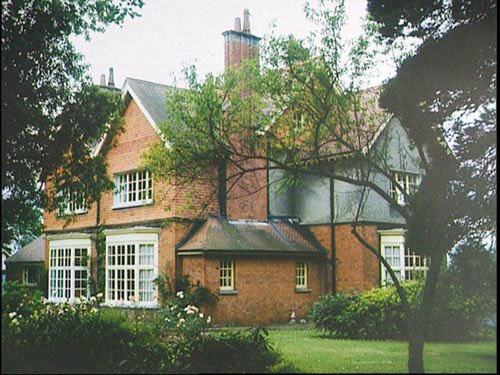
[Image: Little Lea, Belfast]

MARIAN VAN TIL (Associate Editor, Christian Courier, St. Catharines, Ont./Lewiston, NY) writes in MERELEWIS:

Long ago I saw a minute or two of a filmed version of him reading in a BBC studio but I didn't recall the voice. I expected him to sound slightly more Irish. It took some getting used to to match the voice and the face/personality that we've come to know.

The voice, at first hearing, is one of those perennial snobbish-sounding, upper-crust British accents that everyone likes to imitate. I can understand why Lewis was apparently taken aback and said he didn't like the way he sounded when he heard himself on tape for the first time.

Very, very ‘Oxford.’ But then you begin to hear other nuances. In fact, I kept thinking: 'Who does he sound like?' There's an actor who pronounces some of his words like that, and has a similar vocal quality. I finally had it: that actor is Sean Connery. I can't explain that in terms of the origins of and influences on their accents, obviously, but there are some definite similarities.
Another interesting tidbit: Lewis pronounces the word "supposed"/"supposal" (which he used frequently when speaking of Williams) with interior "b's" rather than "p's."

DOUGLAS GRESHAM responded:
'Its more of a subdued labial-stopped "p" than a "b", and it sounds more pronounced in recordings (particularly if the quality isn't the best) than it did in real life. It was almost the only shadow of Northern Ireland that years of Public School and Oxford had left in Jack's accent.'

JAMES O'FEE added:
'Ulster, and Belfast, speech is strongly influenced by Scottish patterns. (This might explain the resemblance with the speech of Scotsman Sean Connery.)


In James Como's C. S. LEWIS AT THE BREAKFAST TABLE (Harvest, Harcourt Brace, New York, 1982) we find:

  1. (page 6) Leo Baker writes of CSL speaking, as an undergraduate after WW1, 'with the slight remains of a Belfast accent'; and
  2. (page 440) Derek Brewer writes of Lewis, as a tutor at Oxford, rather later in life: "The plump cheerful man....who rolled his Rs".

The 'rolled', or 'trilled', R occurs in several varieties of British speech, notably Scots. Yet I confess that I can find little Irish, or Ulster, in the recordings of Lewis that I've heard. Nor a rolled R.'


DOUGLAS GRESHAM replied:
I never heard Jack roll or trill (not the same thing by the way) an "R" at all. And as you say there was barely a trace of Ulster left in his accent. Though of course both he and Warnie could put it on when humour required.


JAMES O'FEE again:
For example, Derek Brewer writes [C. S. LEWIS AT THE BREAKFAST TABLE, ed. James Como, New York, 1982, page 50]:


[Lewis] 'was once on a committee with [T. S.] Eliot to revise the translation of the Psalms and referred to himself, in comparison with Eliot, as a "whippersnapper" - pronounced very Irish, with aspirated initial WH with strongly rolled Rs.'


C S Lewis Centenary Group
Number 11, April 1998


Posted by Picasa

Commercial Xmas


“Christmas cards in general and the whole vast commercial drive called ‘Xmas’ are one of my pet abominations: I wish they could die away and leave the Christian feast unentangled. Not of course that even secular festivities are, on their own level, an evil: but the laboured and organised jollity of this – the spurious childlikeness – the half-hearted and sometimes rather profane attempts to keep us some superficial connection with the Nativity – are disgusting.”

C.S. Lewis
Collected Letters, Volume III, page 686

Posted by Picasa

Jack's last letter...

21 Nov 63


Dear Philip Thompson,

To begin with, may I congratulate you on writing such a remarkably good letter; I certainly could not have written it at your age. And to go on with, thank you for telling me that you like my books, a thing an author is always pleased to hear. It is a funny thing that all the children who have written to me see at once who Aslan is, and grown ups never do!

I have’nt (sic) myself read the Puffin reprint you refer to, so of course missed the fault; but I will call the publisher’s attention to it.

Please tell your father and mother how glad I am to hear that they find my serious books of some value.

With all best wishes to you and to them,

Yours sincerely

C.S. Lewis

Note:
Jack died at around 5:34pm the day after this letter was written: Friday, 22nd November 1963. Warnie’s remembrance of the day, “... at five-thirty I heard a crash and ran in, to find him lying unconscious at the foot of the bed. He ceased to breathe some three or four minutes later.”
Collected Letters – Volume III : “Narnia, Cambridge and Joy 1950-1963” page 1483/4 (Harper Collins – Published this month)*

* Walter Hooper’s Preface is dated 13 September 2006

Postscript:
“What a state we have got into when we can’t say ‘I’ll be happy when God calls me’ without being afraid one will be thought ‘morbid’... if we really believe that our real home is elsewhere... why should we not look forward to the arrival?”
(Letters to an American Lady, 7th June 1959)
Posted by Picasa

Beren Defeated? Or...


He heard afar their hurrying feet,
he snuffed an odour strange and sweet;
he smelled their coming long before____________4200
they marked the waiting threat at door.
His limbs he stretched and shook off sleep,
then stood at gaze. With sudden leap
upon them as they sped he sprang,
and his howling in the arches rang.____________4205
Too swift for thought his onset came,
too swift for any spell to tame;
and Beren desperate then aside
thrust Lúthien, and forth did stride
unarmed, defenceless to defend________________4210
Tinúviel until the end.
With left he caught at hairy throat,
with right hand at the eyes he smote
- his right, from which the radiance welled
of the holy Silmaril he held.__________________4215
As gleam of swords in fire there flashed
the fangs of Carcharoth, and crashed
together like a trap, that tore
the hand about the wrist, and shore
through brittle bone and sinew nesh,___________4220
devouring the frail mortal flesh;
and in that cruel mouth unclean
engulfed the jewel's holy sheen.

Lines 4,198 to 4,223 of the "The Lay of Leithian”

Among Tolkien's papers five more lines were found:

Against the wall then Beren reeled
but still with his left he sought to shield
fair Lúthien, who cried aloud
to see his pain, and down she bowed
in anguish sinking to the ground.

However, JRRT did finish the story. See "The Silmarillion", Chapter 19.Posted by Picasa

The Last Ship (excerpt)


A sudden music to her came,
As she stood there gleaming
With free hair in the morning's flame
On her shoulders streaming.
Flutes there were, and harps were rung,
And there was sound of singing,
Like wind-voices keen and young
And far bells ringing.

JRRT - The Adventures of Tom Bombadil (Unwin 1990)
Posted by Picasa

Dumbledore


Many of those familiar with J.K. Rowling's Harry Potter books, or the films based on them, have been surprised to discover that the name of the headmaster of Hogwarts School also occurs in Tolkien's writings. (They might be even more surprised to find it in Thomas Hardy's The Mayor of Casterbridge.) The word is recorded by the OED as a dialect name for the bumblebee (and certain other insects), with quotations dating back to 1787. Tolkien used it in some versions of his poem "Errantry", in which the 'merry passenger', we are told, "battled with the Dumbledores" (History of Middle Earth VII. 86, 88).

He battled with the Dumbledores,
the Bumbles, and the Honeybees,
and won the Golden Honeycomb;
and running home on sunny seas
in ship of leaves and gossamer
with blossom for a canopy,
he polished up, and furbished up,
and burnished up his panoply.

The Ring of Words - Tolkien and the Oxford English Dictionary (OUP - 2006)
Posted by Picasa

Pocket-handkerchiefs, dwarves, and dragons


Do grown-ups have any business reading The Hobbit? A book about dwarves (Tolkien insisted on this plural), elves, and a race of small people with furry feet, called hobbits, not to mention a wizard, a dragon, and a magic ring - surely these are cliches of fantastic fiction, which adults need not take seriously. What's more, unlike Tolkien's masterpiece, The Lord of the Rings, which was clearly intended for adults, he wrote the original version of The Hobbit for reading aloud to his own children. (No he didn't - ed.)

I would beg to differ. The story of a comfort-loving hobbit who finds himself recruited as a burglar by 13 dwarves keen to avenge the deaths of their forefathers and to recover their ancestral treasure from a dragon has a great deal to tell us about courage - a virtue as important today as it was in the Anglo-Saxon times that Tolkien studied professionally.

Bilbo Baggins is far from being an ancient heroic warrior like Beowulf, though it would have been easy for Tolkien to create a cowardly character who soon leaves behind any sensation of fear and is transformed into a great hero of the old mode. Not not only does Bilbo not kill the dragon: he spends much of the climactic Battle of Five Armies knocked unconscious. On the other hand, only Bilbo has the courage to confront the dragon in his lair, and the humanity to try to stop the fighting.

Tolkien's most perceptive critic to date, Tom Shippey, argues that the hobbits are a bridge between our modern world of safe domesticity and pocket-handkerchiefs (Bilbo discovers he hasn't got any when he runs out of his house to join the dwarves in their adventure), and the frightening but exciting world of heroism, myth, and legend.

Professor Shippey writes: "Much of The Hobbit is about the clash of styles, attitudes, and behaviour patterns [between these two worlds] - though in the end one might conclude that they are not as far apart as they first seemed; that Bilbo has just as much right to the archaic world and its treasures as Thorin or Bard [the heroic warriors]" (J. R. R. Tolkien: Author of the century, HarperCollins, 2001).

But there is more to The Hobbit than an exploration of courage. In Tolkien's essay "On fairy stories", written soon after the publication of The Hobbit, he argued that such stories offer, in addition to the benefits of all good literature, special values that he called "Fantasy, Recovery, Escape, Consolation, all things of which children have, as a rule, less need than older people", adding wryly: "Most of them are nowadays very commonly considered to be bad for anybody" (Tree and Leaf, George Allen & Unwin, 1964).

'Fantasy' is not a word with high status in contemporary Western culture. Indeed, so impoverished is our view of the imagination that popular entertainment prefers the contrivances of reality TV to made-up stories, and some serious writers can add gravitas to their work only by transcribing the actual words of people caught up in historic events. But, for Tolkien, the imagination was one of our most distinctively human attributes: a key element of the divine image in human beings.

He called the creation of an imaginatively consistent secondary world 'sub-creation', and wrote in a poem that he gave to C. S. Lewis (and which was a significant factor in Lewis's conversion to Christianity) "we make still by the law in which we are made" (quoted in Tree and Leaf).

By 'Recovery', Tolkien meant a rediscovery of the freshness and vitality of the world, especially the natural world and humanity's pre-industrial artefacts, such as bread and wine. Fairy stories help to free us from the drabness and triteness of our contemporary view of the world, where the enormous material wealth many of us have has blurred our vision and narrowed our focus to 'getting and spending', as William Wordsworth put it.

In praising 'Escape', Tolkien knew he was moving on to controversial ground, but, as he said, the people who are most against anyone's escaping are jailers. "Why should a man be scorned if, finding himself in prison, he tries to get out and go home? Or if, when he cannot do so, he thinks and talks about other topics than jailers and prison-walls?"

'Consolation' was only one of Tolkien's names for what he regarded as the highest value of the fairy tale. By it, he meant that all true and complete fairy stories must have a happy ending, which he also called 'eucatastrophe', "a sudden and miraculous grace: never to be counted on to recur". He saw this as "a fleeting glimpse of Joy, Joy beyond the walls of the world, poignant as grief".

Unperceptive critics of Tolkien often accuse him of writing sentimental happy endings. In fact, Tolkien viewed life with a robust honesty, not denying that the world is full of suffering (both his parents had died by the time he was 12, and he fought in the First World War), and yet insisting that salvation can come when it is least expected.

Perhaps the most striking example of this in The Hobbit is when, at the climax of the Battle of Five Armies, Bilbo cries out: "The Eagles are coming!" There may be an implicit reference here to Christian iconography, but, more importantly, it underlines the fact that, no matter how hard we strive, we have no power, of ourselves, to save ourselves.

Jennifer Swift
(A fiction writer, a member of the Oxford C. S. Lewis Society, and has taught courses on the Inklings).

The Hobbit by J. R. R. Tolkien is published by HarperCollins.

Published in the Church Times - 3rd November 2006 Posted by Picasa

In a Punt on the Cherwell

  Posted by Picasa
For he (Lewis) talked like an angel. My idea of how angels might talk derives from Lewis. His prose is brilliant, amusing, intimate, cogent; but his talk was of a superior order. It combined fluent, informal progression with the most articulate syntax, as if, somehow, it was a text remembered – and remembered perfectly. The steps of his argument succeeded without faltering, with each quotation in the original tongue, well pronounced. (To keep up his half dozen languages he belonged to reading groups – J. R. R. Tolkien’s Kolbitar for Norse, the Dante Society for Italian, another group for Homeric Greek.) Add an extraordinary memory, and you can see how any situation was for him accompanied by a full-voiced choir of verbal associations. "Probably no reader," he writes, "comes upon Lydgate’s ‘I herd other crie’ without recalling ‘the voces vagitus et ingens in Virgil’s hell.’" For this assumption, Lewis has been called "bookish" – a dumbed down response. Of course he was bookish; hang it, he tutored in literature. Even standing on the high end of a punt in a one piece swimming costume with a single shoulderstrap, about to dive, he had time for a quotation, half heard over the water, something about silvestrem. Was he teasing me for reclining at ease in my punt...

Alastair Fowler
Yale Review, Vol. 91 No. 4 (October 2003), pp. 64–80

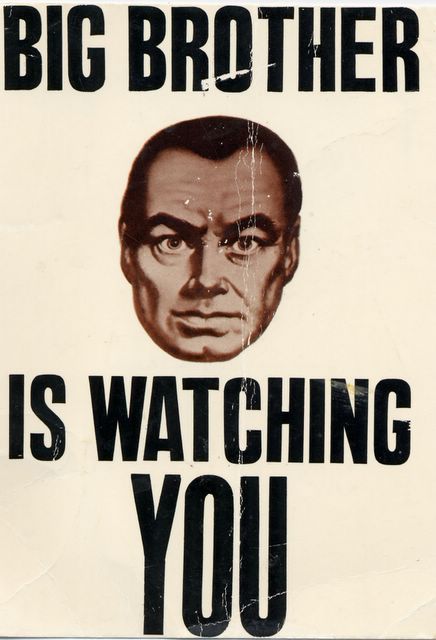
1984 and That Hideous Strength


There are interesting parallels between Lewis's vision and that of George Orwell, despite the fact that Orwell had disliked Lewis's wartime religious broadcasts.

Orwell reviewed the book for the Manchester Evening News, commenting "Plenty of people in our age do entertain the monstrous dreams of power that Mr. Lewis attributes to his characters, and we are within sight of the time when such dreams will be realisable."

In some ways That Hideous Strength can be seen as describing one of the possible paths to a 1984 - one 1984, even if not quite Orwell's. The review was in 1945, before Orwell wrote 1984, and so That Hideous Strength may be considered as a possible influence.

(Source - Wikepedia)
 Posted by Picasa

That Hideous Strength (1945)


In C. S. Lewis' novel, the technological super-agency is the National Institute of Coordinated Experiments (NICE), which is empowered to solve all sorts of social and genetic problems without being bothered by "red tape." Mark and Jane Studdock are a young childless academic couple at Bracton College, whose faculty's Progressive Element is willing to sell its woods and its soul to entice the NICE. Mark and Jane's marriage is unhappy because, like most modern people, they see marriage as a contract for mutual advantage rather than as a sacred union. Mark's consuming desire doesn't even involve Jane. He wants to be a big shot, a member of the "inner ring" first at his college and then at the NICE. He gets his chance because he is good at writing propaganda.

(Phillip E. Johnson - First Things - March 2000)
[To read the whole piece, click on the title above]
 Posted by Picasa

Charles Williams on PG Wodehouse


Barbara stretched out her hands, and Lionel pulled her to her feet. "I just want to shimmer up, like Jeeves, not walk," she said. "Do you like Jeeves, Mr. Persimmons?"
Jeeves?" Gregory asked. "I don't think I know it or him or them."
"Oh, you must," Barbara cried. "When I get back to London I'll send you a set."
"It's a book, or a man in a book," Lionel interrupted. "Barbara adores it."
"Well, so do you," Barbara said. "You always snigger when you read him."
"That is the weakness of the flesh," Lionel said. "One whouldn't snigger over Jeeves any more than one should snivel over Othello. Perfect art is beyond these easy emotions. I think Jeeves -- the whole book, preferably with the illustrations -- one of the final classic perfections of our time. It attains absolute being. Jeeves and his employer are one and yet diverse. It is the Don Quixote of the twentieth century."
"I must certainly read it," Gregory said, laughing. "Tell me more about it while we have tea."

War In Heaven (Eerdmans 1978), page 157-8
Charles Williams 1930

 Posted by Picasa

Screwtape writes to his apprentice-devil nephew


Music and silence -- how I detest them both! How thankful we should be that ever since Our Father entered Hell -- though longer ago than humans, reckoning in light years, could express -- no square inch of infernal space and no moment of infernal time has been surrendered to either of those abominal forces, but all has been occupied by Noise -- Noise, the grand dynamism, the audible expression of all that is exultant, ruthless, and virile -- Noise which alone defends us from silly qualms, despairing scruples and impossible desires. We will make the whole universe a noise in the end. We have already made great strides in this direction as regards the Earth. The melodies and silences of Heaven will be shouted down in the end. But I admit we are not yet loud enough, or anything like it. Research is in progress. Meanwhile, you, disgusting little --

[Here the MS breaks off and is resumed in a different hand.]

In the heat of composition I find that I have inadvertantly allowed myself to assume the form of a large centipede. I am accordingly dictating the rest to my secretary. Now that the transformation is complete I recognise it as a periodical phenomenon. Some rumour of it has reached the humans and a distorted account of it appears in the poet Milton, with the ridiculous addition that such changes of shape are a 'punishment' imposed on us by the Enemy. A more modern writer -- someone with a name like Pshaw -- has, however, grasped the truth. Transformation proceeds from within and is a glorious manifestation of that Life Force which Our Father would worship if he worshipped anything but himself. In my present form I feel even more anxious to see you, to unite you to myself in an indissoluble embrace,

(signed) Toadpipe (for his Abysmal Sublimity Under Secretary Screwtape, TE, BS, etc.)

C.S. Lewis, The Screwtape Letters, Ch. 22, (1942)
 Posted by Picasa

The Geste of Beren and Luthien


Book XIII.

Into the vast and echoing gloom,
more dread than many-tunnelled tomb
in Labyrinthine pyramid
where everlasting death is hid,
down awful corridors that wind
down to a menace dark enshrined;
down to the mountain's roots profound,
devoured, tormented, bored and ground
by seething vermin spawned of stone;
down to the depths they went alone.

(J.R.R. Tolkien)
 Posted by Picasa

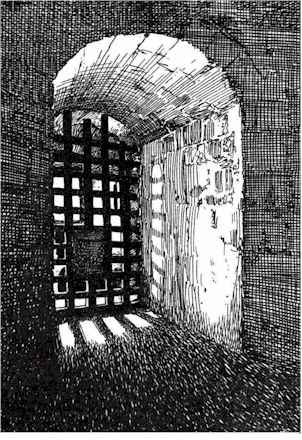
Spirits in Bondage


So piteously the lonely soul of man
Shudders before this universal plan,
So grievous is the burden and the pain,
So heavy weighs the long, material chain
From cause to cause, too merciless for hate,
The nightmare march of unrelenting fate,
I think that he must die thereof unless
Ever and again across the dreariness
There came a sudden glimpse of spirit faces,
A fragrant breath to tell of flowery places
And wider oceans, breaking on the shore
From which the hearts of men are always sore.

(C.S. Lewis - XV. Dungeon Gates) Posted by Picasa

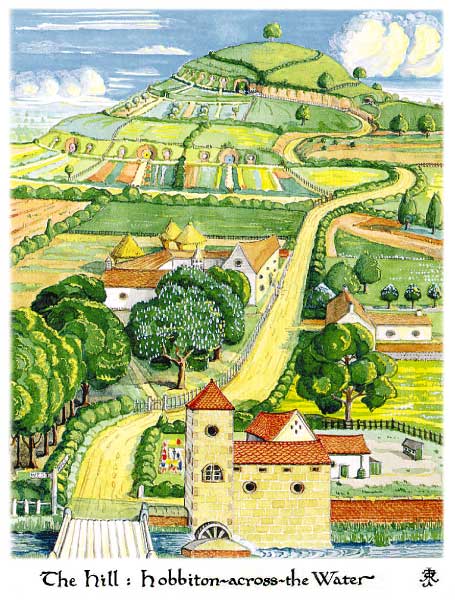
An Unexpected Party


[Hobbiton - JRRT's own painting]

In a hole in the ground there lived a hobbit. Not a nasty, dirty, wet hole, filled with the ends of worms and an oozy smell, nor yet a dry, bare, sandy hole with nothing in it to sit down on or to eat: it was a hobbit-hole, and that means comfort.

It had a perfectly round door like a porthole, painted green, with a shiny yellow brass knob in the exact middle. The door opened on to a tube-shaped hall like a tunnel: a very comfortable tunnel without smoke, with panelled walls, and floors tiled and carpeted, provided with polished chairs, and lots and lots of pegs for hats and coats - the hobbit was fond of visitors. The tunnel wound on and on, going fairly but not quite straight into the side of the hill - The Hill, as all the people for many miles round called it - and many little round doors opened out of it, first on one side and then on another. No going upstairs for the hobbit: bedrooms, bathrooms, cellars, pantries (lots of these), wardrobes (he had whole rooms devoted to clothes), kitchens, dining-rooms, all were on the same floor, and indeed on the same passage. The best rooms were all on the left-hand side (going in), for these were the only ones to have windows, deep-set round windows looking over his garden, and meadows beyond, sloping down to the river.

The Hobbit - Chapter 1
 Posted by Picasa

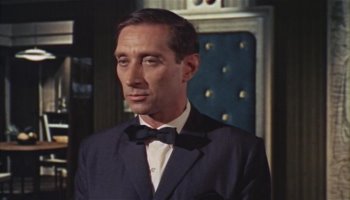
The Inklings connection with 007 !


The year was 1959, Polish actor Vladek Sheybal arrived in England not knowing anyone and unable to speak English. He supported himself by working in menial jobs in a Polish delicatessen and then in an artifical jewellery shop in Brick Lane, London. When he finished his job at the jewellery shop, he took a train from Paddington station to Oxford with all his worldy goods in a small suitcase, and the only money he had in the world -- ten English pounds.

Soon after Vladek arrived in Oxford, the typical English weather turned sour and it began to rain. Taking refuge in a coffee shop, he was recognised and later befriended, by students who had seen the Polish film "Kanal" (1956) in which Vladek was featured, the night before at their local cinema -- a film as poignant and thought provoking now as it was then. Eventually, Vladek became a recognised student of English Literature at Merton College, Oxford after being taken under the wing of Professor Neville Coghill.

In 1963, Vladek was offered a small part in the second James Bond film 'From Russia with Love' but was reluctant to take the part and turned it down. Eventually he was persuaded by Sean Connery (who was by now a close friend) to take the role of the villanous chess master 'Kronsteen'. Vladek played the part as usual, to perfection; creating a character so elegantly arrogant that 'Kronsteen' is perhaps the most believable and memorable Bond villains of the entire genre.

Wonder if Vladek met the rest of the Inklings whilst at Merton? After all J.R.R. Tolkien, Neville Coghill and Hugo Dyson were all fellows at Merton in the 1950s. Posted by Picasa