Sorry that there will be a bit of a hiatus during my absence in 'foreign parts' for the next 10 weeks. I will try to post on occasion, but without regular access to a computer this might prove difficult.
Roger R.


"Susan, Eve's Daughter," said Father Christmas.
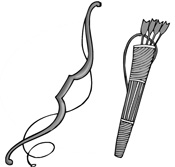
"Susan, Eve's Daughter," said Father Christmas. "These are for you," and he handed her a bow and a quiver full of arrows and a little ivory horn. "You must use the bow only in great need," he said, "for I do not mean you to fight in the battle. It does not easily miss. And when you put this horn to your lips; and blow it, then, wherever you are, I think help of some kind will come to you."
Last of all he said, "Lucy, Eve's Daughter," and Lucy came forward. He gave her a little bottle of what looked like glass (but people said afterwards that it was made of diamond) and a small dagger. "In this bottle," he said, "there is cordial made of the juice of one of the fireflowers that grow in the mountains of the sun. If you or any of your friends is hurt, a few drops of this restore them. And the dagger is to defend yourse at great need. For you also are not to be in battle."
"Why, sir?" said Lucy. "I think - I don't know but I think I could be brave enough."
"That is not the point," he said. "But battles are ugly when women fight."
C.S. Lewis, The Lion, the Witch and the Wardrobe, (1950)

All Hallows Eve
Lester looked round her. She saw the stars; she saw the lights; she saw dim shapes of houses and trees in a landscape which was less familiar through being so familiar. She could not even yet manage to enunciate to her companion the word death. The landscape of death lay round them; the future of death awaited them. Let them go to it; let them do something. She thought of her own flat and of Richard-no. She did not wish to take this other Evelyn there; besides, she herself would be, if anything at all, only a dim shadow to Richard, a hallucination or a troubling apparition. She could not bear that, if it could be avoided; she could not bear to be only a terrifying dream. No; they must go elsewhere. She wondered if Evelyn felt in the same way about her own home. She knew that Evelyn had continuously snubbed and suppressed her mother, with whom she lived; once or twice she had herself meant to say something, if only out of an indifferent superiority. But the indifference had beaten the superiority. It was now for Evelyn to choose. She said: "Shall we go to your place?"
Evelyn said shrilly: "No; no. I won't see Mother. I hate Mother."
Lester shrugged. One way and another, they did seem to be rather vagrants, unfortunate and helpless creatures, with no purpose and no use. She said: "Well . . . let's go." Evelyn looked up at her. Lester, with an effort at companionship, tried to smile at her. She did not very well succeed, but at least Evelyn, slowly and reluctantly, got to her feet. The lights in the houses had gone out, but a faint clarity was in the air -perhaps (though it had come quickly) the first suggestion of the day. Lester knew exactly what she had better do, and with an effort she did it. She took Evelyn's arm. The two dead girls went together slowly out of the Park.
Charles Williams : All Hallows Eve (Last paragraphs of Chapter 1 - The New Life)
I am sure...

... that some are born to write as trees are born to bear leaves: for these, writing is a necessary mode of their own development. If the impulse to write survives the hope of success, then one is among these. If not, then the impulse was at best only pardonable vanity, and it will certainly disappear when the hope is withdrawn.
C.S. Lewis to Arthur Greeves
The Letters of C.S. Lewis, (28 August 1930)
Beren & Lúthien in Angband
(Lines 3850 - 3865 of the The Geste of Beren and Lúthien)
Into the vast and echoing gloom,________________3850
more dread than many-tunnelled tomb
in Labyrinthine pyramid
where everlasting death is hid,
down awful corridors that wind
down to a menace dark enshrined;_______________3845
down to the mountain's roots profound,
devoured, tormented, bored and ground
by seething vermin spawned of stone;
down to the depths they went alone.
The arch behind of twilit shade________________3850
they saw recede and dwindling fade;
the thunderous forges' rumour grew,
a burning wind there roaring blew
foul vapours up from gaping holes.
Huge shapes there stood like carven trolls_____3855
enormous hewn of blasted rock
to forms that mortal likeness mock;
monstrous and menacing, entombed,
at every turn they silent loomed
in fitful glares that leaped and died._________3860
There hammers clanged, and tongues there cried
with sound like smitten stone; there wailed
faint from far under, called and failed
amid the iron clink of chain
voices of captives put to pain.________________3865
(JRRT)
Into the vast and echoing gloom,________________3850
more dread than many-tunnelled tomb
in Labyrinthine pyramid
where everlasting death is hid,
down awful corridors that wind
down to a menace dark enshrined;_______________3845
down to the mountain's roots profound,
devoured, tormented, bored and ground
by seething vermin spawned of stone;
down to the depths they went alone.
The arch behind of twilit shade________________3850
they saw recede and dwindling fade;
the thunderous forges' rumour grew,
a burning wind there roaring blew
foul vapours up from gaping holes.
Huge shapes there stood like carven trolls_____3855
enormous hewn of blasted rock
to forms that mortal likeness mock;
monstrous and menacing, entombed,
at every turn they silent loomed
in fitful glares that leaped and died._________3860
There hammers clanged, and tongues there cried
with sound like smitten stone; there wailed
faint from far under, called and failed
amid the iron clink of chain
voices of captives put to pain.________________3865
(JRRT)
YOU MUST LOOK AT IT TODAY... [Click Here]
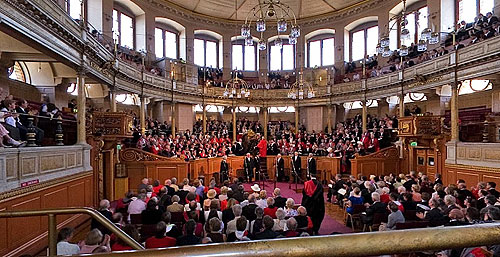
An ever-expanding Virtual Tour of Oxford University and City.
Now with over 2,500 panoramas from all around Oxford, including most of the colleges, including "JRR Tolkien's Oxford" - exploring some of JRRT's favourite places.
You have total control over each image... the floor of the "University Schools Building" is worth the visit on its own. Amazing.... GO NOW!
Jack and Joy... and marriage

For we did learn and achieve something. There is, hidden or flaunted, a sword between the sexes till an entire marriage reconciles them. It is arrogance in us to call frankness, fairness, and chivalry 'masculine' when we see them in a woman; it is arrogance in them, to describe a man's sensitiveness or tact or tendernesss 'feminine.' But also what poor, warped fragments of humanity most mere men and mere women must be to make the implications of that arrogance plausible. Marriage heals this. Jointly the two become fully human. 'In the image of God created He them.' Thus, by a paradox, this carnival of sexuality leads us out beyond our sexes.
A Grief Observed
The famous Jack Lewis quote on Marriage...
C.S. Lewis on Marriage Protection
“... I should like to distinguish two things which are very often confused. The Christian conception of marriage is one: the other is the quite different question -- how far Christians, if they are voters or Members of Parliament, ought to try to force their views of marriage on the rest of the community by embodying them in the divorce laws. A great many people seem to think that if you are a Christian yourself you should try to make divorce difficult for every one.
I do not think that. At least I know I should be very angry if the Mahommedans (sic) tried to prevent the rest of us from drinking wine. My own view is that the Churches should frankly recognise that the majority of the British people are not Christians and, therefore, cannot be expected to live Christian lives. There ought to be two distinct kinds of marriage: one governed by the State with rules enforced on all citizens, the other governed by the Church with rules enforced by her on her own members. The distinction ought to be quite sharp, so that a man knows which couples are married in a Christian sense and which are not.
From Mere Christianity, Chapter 16:
Is he right? (RR)
“... I should like to distinguish two things which are very often confused. The Christian conception of marriage is one: the other is the quite different question -- how far Christians, if they are voters or Members of Parliament, ought to try to force their views of marriage on the rest of the community by embodying them in the divorce laws. A great many people seem to think that if you are a Christian yourself you should try to make divorce difficult for every one.
I do not think that. At least I know I should be very angry if the Mahommedans (sic) tried to prevent the rest of us from drinking wine. My own view is that the Churches should frankly recognise that the majority of the British people are not Christians and, therefore, cannot be expected to live Christian lives. There ought to be two distinct kinds of marriage: one governed by the State with rules enforced on all citizens, the other governed by the Church with rules enforced by her on her own members. The distinction ought to be quite sharp, so that a man knows which couples are married in a Christian sense and which are not.
From Mere Christianity, Chapter 16:
Is he right? (RR)
Tolkien on Marriage
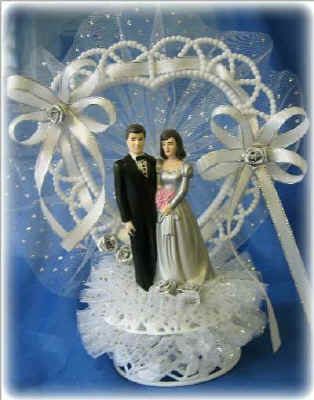
Nearly all marriages, even happy ones, are mistakes: in the sense that almost certainly (in a more perfect world, or even with a little more care in this very imperfect one) both partners might be found more suitable mates. But the real soul-mate is the one you are actually married to.
J.R.R. Tolkien, Letter to Michael Tolkien, March 1941
Eden's Courtesy
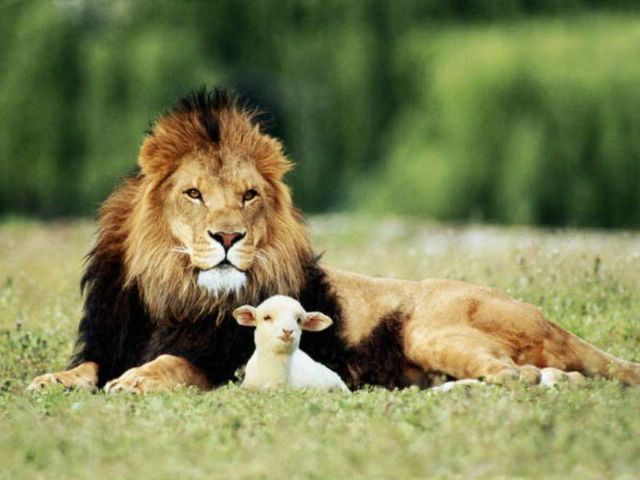
Such natural love twixt beast and man we find
That children all desire an animal book,
And all brutes, not perverted from their kind,
Woo us with whinny, tongue, tail, song, or look;
So much of Eden's courtesy yet remains.
But when a creature's dread, or mine, has built
A wall between, I think I feel the pains
That Adam earned and do confess my guilt.
For till I tame sly fox and timorous hare
And lording lion in my self, no peace
Can be without; but after, I shall dare
Uncage the shadowy zoo and war will cease;
Because the brutes within, I do not doubt,
Are archetypal of the brutes without.
C. S. Lewis, Poems, "Eden's Courtesy" (1964)
Despair?

"I will not seek it," the other replied.
"It has been opened once and it is enough. And you,are you sure that man can conquer until he has been wholly defeated? Are you sure that he can find plenitude till he has known utter despair? You will not let him despair of himself, but it may be that only in such a complete despair he finds that which cannot despair and is something other than man."
Shadows of Ecstasy - Charles Williams / ch.11
The Other Mrs. Moore
"There was in the grounds of The Kilns when I arrived there, away over beyond the desolate tennis court, a small two roomed weather-board shack. It was almost completely overgrown with creepers and bushes and was evidently not in use for any purpose. When I asked Fred Paxford about it he told me that it had been "Mrs Moore's house", and it had been built for her use. On further inquiry I came to understand that the "Mrs Moore" in question had been a family friend and had fallen on hard times and thus had been brought into the household in Ireland to "help", and that when things became very hard in her later life, Jack and Warnie had "rescued" her, brought her over from Ireland, and built that little bungalow for her so that she could spend her declining last years in peace and without worry.
This information may or may not be completely accurate as it was gleaned over a period of time; neither Jack nor Warnie would ever openly talk about their charitable works. The little house later became my "Gang Hut" (rather a posh one actually as it had two rooms and a coal fired heating stove) and also an alternative "sleep-out" bedroom for me to use when I was feeling adventurous or whatever.
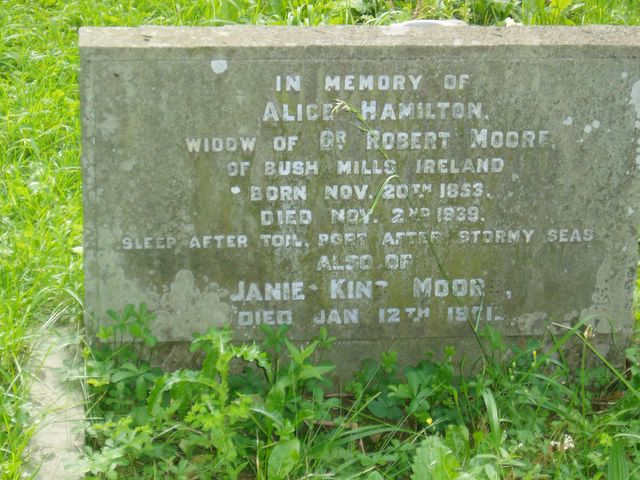
I visited Mrs Moore's grave only a few weeks ago as it happens in order to point it out to some visitors. She shares the burial place of her Earthly residue with that of the other Mrs Moore, at Holy Trinity Church, Headington Quarry.
Douglas Gresham - Lenten Lands (1988)
Time Magazine
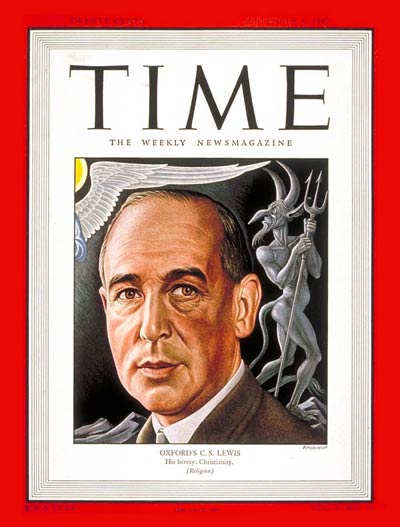
Above is the cover of the issue of Time Magazine which featured Lewis in the context of his novel work on spirituality, The Screwtape Letters.
In his original preface to the book, he astutely noted, "there are two equal and opposite errors into which our race can fall about the devils. One is to disbelieve in their existence. The other is to believe, and to feel an excessive and unhealthy interest in them. They themselves are equally pleased by both errors..."
To Laurence Harwood
Nothing much has happened to me except that I saw a rabbit yawn. I suppose people who keep tame ones have seen it often but this was a wild rabbit and I thought it a v. curious sight. It was a very bored triangular yawn in the middle of a long hot afternoon...
C.S. Lewis
December 23rd, 1947
C.S. Lewis
December 23rd, 1947
Looking 'Along' and Looking 'At'
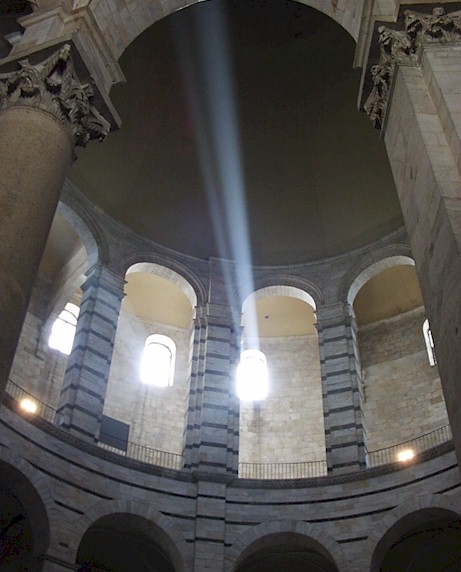
I was standing today in the dark toolshed. The sun was shining outside and through the crack at the top of the door there came a sunbeam. From where I stood that beam of light, with the specks of dust floating in it, was the most striking thing in the place. Everything else was almost pitch black. I was seeing the beam, not seeing things by it.
Then I moved, so that the beam fell on my eyes. Instantly the whole previous picture vanished. I saw no toolshed, and (above all) no beam. Instead I saw, framed in the irregular cranny at the top of the door, green leaves moving on the branches of a tree outside and beyond that, ninety-odd million miles away, the sun. Looking along the beam, and looking at the beam are very different experiences.
But this is only a very simple example of the difference between looking at and looking along. A young man meets a girl. The whole world looks different when he sees her. Her voice reminds him of something he has been trying to remember all his life, and ten minutes' casual chat with her is more precious than all the favours that all other women in the world could grant. He is, as they say, 'in love'. Now comes a scientist and describes this young man's experience from the outside. For him it is all an affair of the young man's genes and a recognized biological stimulus. That is the difference between looking along the sexual impulse and looking at it.
C.S. Lewis, "Meditation in a Toolshed"
1st published in The Coventry Evening Telgraph (17 July 1945)
James Bond - An Inklings connection!

The year was 1959, Polish actor Vladek Sheybal arrived in England not knowing anyone and unable to speak English. He supported himself by working in menial jobs in a Polish delicatessen and then in an artifical jewellery shop in Brick Lane, London. When he finished his job at the jewellery shop, he took a train from Paddington station to Oxford with all his worldy goods in a small suitcase, and the only money he had in the world -- ten English pounds.
Soon after Vladek arrived in Oxford, the typical English weather turned sour and it began to rain. Taking refuge in a coffee shop, he was recognised and later befriended, by students who had seen the Polish film "Kanal" (1956) in which Vladek was featured, the night before at their local cinema -- a film as poignant and thought provoking now as it was then. Eventually, Vladek became a recognised student of English Literature at Merton College, Oxford after being taken under the wing of Professor Neville Coghill.
In 1963, Vladek was offered a small part in the second James Bond film "From Russia with Love" but was reluctant to take the part and turned it down. Eventually he was persuaded by Sean Connery (who was by now a close friend) to take the role of the villanous chess master 'Kronsteen'. Vladek played the part as usual, to perfection; creating a character so elegantly arrogant that 'Kronsteen' is perhaps the most believable and memorable Bond villains of the entire genre.
Wonder if Vladek met the rest of the Inklings whilst at Merton? After all J.R.R. Tolkien, Neville Coghill and Hugo Dyson were all fellows at Merton in the 1950s.
Under the Mercy
The grave of Charles Williams in an Oxford churchyard is marked by a stone bearing his name and the terse description: Poet, followed by the words, Under the Mercy.
Under the Mercy is a phrase that appears frequently in his writings, as it did in his conversation. He liked to refer to the Divinity by Its Attributes: the Mercy, the Protection, the Omnipotence. In his personal life he seemed always to be clinging to the faith that, balanced as he was upon the knife-edge of his Christian allegiance in the world of myth and magic that his passion-inflamed imagination had conjured up, he would find at last, in death if by no other route, the stillness of the Love of God. It was his wife, Michal, in one of those sudden flashes of crystal-clear insight of which she was not infrequently capable, who chose the inscription on the stone. Nothing could have been more appropriate.
Lois Lang-Sims: "Letters to Lalange – The Letters of Charles Williams to Lois Lang-Sims", page 16
Under the Mercy is a phrase that appears frequently in his writings, as it did in his conversation. He liked to refer to the Divinity by Its Attributes: the Mercy, the Protection, the Omnipotence. In his personal life he seemed always to be clinging to the faith that, balanced as he was upon the knife-edge of his Christian allegiance in the world of myth and magic that his passion-inflamed imagination had conjured up, he would find at last, in death if by no other route, the stillness of the Love of God. It was his wife, Michal, in one of those sudden flashes of crystal-clear insight of which she was not infrequently capable, who chose the inscription on the stone. Nothing could have been more appropriate.
Lois Lang-Sims: "Letters to Lalange – The Letters of Charles Williams to Lois Lang-Sims", page 16
Williams on Adam and Eve

They had what they wanted. That they did not like it when they got it does not alter the fact that they certainly got it.
(He Came Down From Heaven)
Sweeter also than honey...

"More to be desired are they than gold, yea than much fine gold: sweeter also than honey and the honeycomb" (Psalm 19).
One can well understand this being said of God's mercies, God's visitations, His attributes. But what the poet is actually talking about is God's law, His commands; His "ruling" as Dr. Moffatt well translates in verse 9 (for "judgements" here plainly means decisions about conduct). What is being compared to gold and honey is those "statutes" (in the Latin version "decrees") which, we are told, "rejoice the heart". For the whole poem is about the Law, not about "Judgement" in the sense to which Chapter I was devoted.
This was to me at first very mysterious. "Thou shalt not steal, thou shalt not commit adultery" - I can understand that a man can, and must, respect these "statutes", and try to obey them, and assent to them in his heart. But it is very hard to find how they could be, so to speak, delicious, how they exhilarate. If this is difficult at any time, it is doubly so when obedience to either is opposed to some strong, and perhaps in itself innocent, desire. A man held back by his unfortunate previous marriage to some lunatic or criminal who never dies from some woman whom he faithfully loves, or a hungry man left alone, without money, in a shop filled with he smell and sight of new bread, roasting coffee, or fresh strawberries - can these find the prohibition of adultery or of theft at all like honey? They may obey, they may still respect the "statute", but surely it could be more aptly compared to the dentists's forceps or the front line than to anything enjoyable and sweet.
C.S. Lewis, Reflections on the Psalms, Chapter VI "Sweeter Than Honey" (1955)

The Inquisition

One might think that the phrase of Lord Acton (that "it cannot really be held that in Rome sixteen centuries after Christ men did not know that murder was wrong") might be held to apply [to the Inquisition]; it cannot be that men did not think such methods doubtfully holy. It was not so. Deep, deeper than we believe, lie the roots of sin; it is in the good that they exist; it is in the good that they thrive and send up sap and produce the black fruits of hell. The peacock fans of holy and austere popes drove the ashes of burning men over Christendom.
Charles Williams - The Descent of the Dove
Subscribe to:
Posts (Atom)

 Posts
Posts

